Sunday, December 30, 2007
The Edge of Heaven (Auf der anderen Seite)
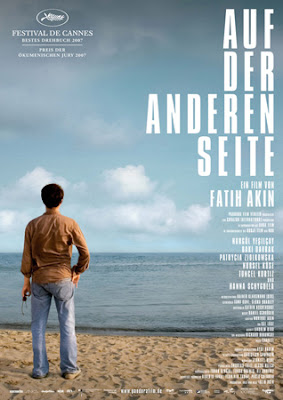
The 13th annual Berlin and Beyond Film Festival will open with "The Edge of Heaven" ("Auf der anderen Seite," Germany 2007, 122 min.) on January 10, 2008 at the Castro Theatre.
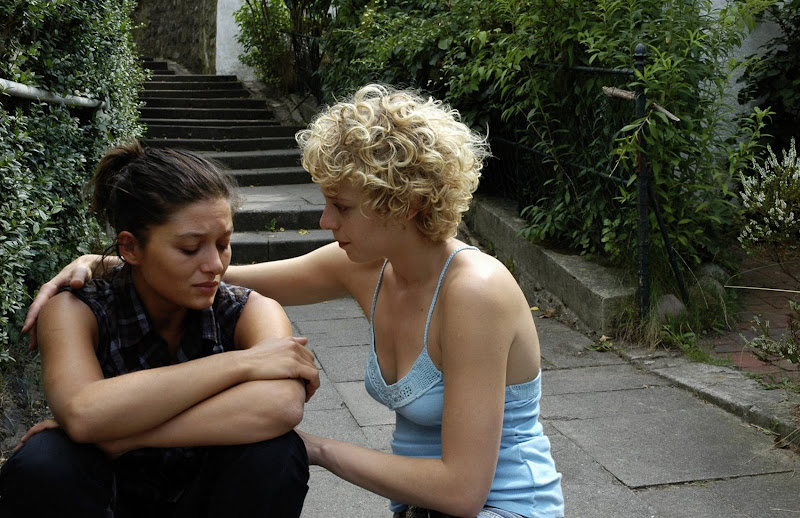
Superbly written and directed by Turkish German director Fatih Akın, "The Edge of Heaven" tells a compelling story about love, hope, loss, grief, and forgiveness. Turkish immigrant Nejat teaches at a German university and lives with his widower father Ali. Ali meets a Turkish born prostitute Yeter and invites her to move in with them. Yeter supports her daughter Ayten who studies in Turkey by sending back money to her. A series of events send Nejat to Turkey searching for Yeter's daughter Ayten, while Ayten comes to Germany searching for her mother Yeter. Ayten finds help from a German student Lotte and falls in love with her while Nejat's search continues. These characters constantly come across each other's lives without knowing it. They keep up their hopes and dreams, deal with their losses and grief, and search for reconciliation and forgiveness. This film is precisely and efficiently constructed. Its storytelling is amazingly effective. One of my favorite scenes is when a coffin in and out a Turkish Airline airplane. It carries tremendous amount of emotion without a single word.
I am not surprised that the film won the best screenplay award at this year's Cannes Film Festival. Some film writers seem lazy to me when they take shortcuts with their plots. For example, they arrange their characters to run into each other in a crowd of thousands of people, or on a street in a city like New York or Paris. That doesn't happen in this film. Quite contrary, characters in this film seem always miss each other. There are so many moments that they could have solved the puzzle, but with one small simple mishap, they miss again. "The Edge of Heaven" is German's entry for this year's Oscar contest.
With more than 35 films from Germany, Switzerland, and Austria, the 13th annual Berlin and Beyond Film Festival runs January 10-16, 2008 at Castro Theatre and Goethe-Institut in San Francisco. |
Labels: Berlin and Beyond 2008


Wednesday, December 12, 2007
Juno
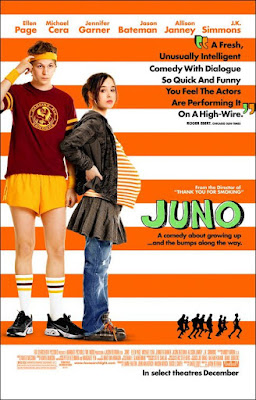
Ellen Page outstandingly plays sixteen years old Juno, who gets pregnant by her shy classmate Paulie Bleeker (a name that is funny already to me), brilliantly played by Michael Cera. Juno decides not to have an abortion, but puts the baby up for an adoption. The film unfolds the pregnancy and adoption story, and creates a few more funny yet complex characters. If you think you have seen enough quirky teenagers in recent films such as "Napoleon Dynamite," that's because you have not met Juno yet. Juno is the queen of all of those teenagers. She always has the sharpest tongue knocking people around, thanks to the smart and splendid screenplay by Diablo Cody (who is on strike right now by the way). Despite that it's unlikely for a sixteen-years-old to be so witty and always to be able to say the smartest lines, Juno appears to be the coolest girl everyone would want to hang out with, even she has a "sea monkey" inside of her and she is underage. Juno's step-mom has a tongue as sharp as Juno, again, thanks to the screenplay. I want to stand up give Juno's step-mom a high five and ask her to adopt me after she shouts back to a technician at a clinic. The film is "OMG funny" in a weird way. Simply just look at the character Michael Cera plays, I start to laugh already. It's like I feel ticklish when I imagine I am tickled. Started with a brilliant screenplay, accompanied with fun songs, acted by an incredible ensemble cast, this terrific comedy might be a surprising dark horse at this year's Oscar race. You just never know what "other kind of shenanigans" this film might get into.
p.s. If you want to see this movie for free before everyone else can see it, check out other advanced screenings in a town near you. |
Tuesday, December 11, 2007
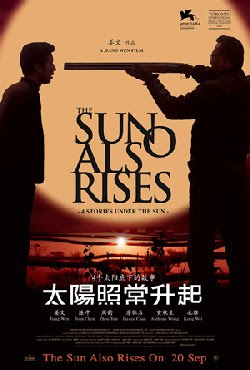
The Sun Also Rises (太阳照常升起)
"The Sun Also Rises" contains loosely connected four stories: "Madness (疯)," "Amativeness (恋)," "Gun (枪)," and "Dream (梦)." In "Madness (疯)," Jaycee Chan plays a son who tries his best to make sense of his mad mother's behavior and to protect her from getting harmed. In "Amativeness (恋)," Joan Chen plays a mistress of Jiang Wen and falls for a teacher (played by Anthony Wong) at a University. In "Gun (枪)," Jiang Wen is exiled to the small village where Jaycee Chan lives with his mad mom in "Madness (疯)." Jiang Wen hunts with a group of children everyday. But one day, he discovers a secret that changes his relationship with Jaycee Chan. In "Dream (梦)," all these characters come together in the Gobi Desert, but eighteen years earlier than the previous stories. It reveals the origins of these characters, in a dream like setting. The opening of the film has the trait of humor similar to "Devils on the Doorstep," but the playful style disappeared later in the film. Joan Chen's character is the most hilarious one among all the characters. She gives her best performance in years. Knowing the film Joan Chen was watching in this film makes the entire episode even funnier. However, Jaycee Chan runs around a little bit too much like his father. His Taiwanese accent is very distracting and distances himself from his character. Liu Ye (刘烨) would have been great for this role, even he is a little older. Watching this film is like reading poetry, but in cinema. I am totally captivated by the enthralling atmosphere and mysterious characters created by rich visual and fascinating imagination. I do not expect the logic behind the happenings in the film fully explained, nor question why Jaycee Chan bares his butt in the film. It's the same reason that I do not read a poem to be read like a novel. The correct translation of the film title "太阳照常升起" should be "The Sun Rises as Usual," which obviously has a different meaning from "The Sun Also Rises." I believe if the title were translated correctly, it would express director Jiang Wen's vision better. Survived from the madness during the Cultural Revolution, we all see hope when the sun seems rising as usual. |