Sunday, April 20, 2008
The 51st SFiFF
The 51st San Francisco International Film Festival (SFiFF) will begin next Thursday, April 24th with Catherine Breillat's "The Last Mistress (Une vieille maîtresse)." The festival will end two weeks later on May 8 with a documentary "Gonzo: The Life and Work of Dr. Hunter S. Thompson" by Oscar-winning director Alex Gibney. During the festival, film lovers will have the opportunity to indulge themselves with more than 100 films and programs from over 50 countries.
OverwhelmedIndeed, there are many films to choose from. The program guide is like a big novel to read—a novel that changes its plot at every turn of the page. To come up an ideal screening schedule can be overwhelming to anyone who does not have a personal assistance. I have been thinking about writing a computer program to do the scheduling. I shall see how far this computer assistance idea can be developed, perhaps it won't go anywhere before the festival is over.However, even if I had a computer program, I would have to answer this question first: "What to see during the festival?"—I get asked by that question a lot. The answer can never be easy. Before answering anybody that question right away, I always ask what their favorite movies are, unless I already know. After getting their answers, I might be able to find some films at the festival that are highly correlated to their liking. To explain this in another way, avoiding statistical concepts, consider that I ask somebody this question: "What is your favorite food if you dine out?" If the answer is a Big Mac from McDonald's, you probably never see me to dine out with this person. Therefore, my picks at the festival might be quite different from others. Or, quite similar. But before I roll out the list, I would like to discuss SFiFF's "Asian flavor." Although this oldest film festival in America is seemly partial to French cinemas (about 20% of this year's films are from France if including co-production), SFiFF always bring forth new excitement from Asian cinemas.
Films about Three GorgesOnly history can tell the significance of the Three Gorges Dam (长江三峡大坝) that is currently being built in China. Its social and economical impact will generate more Ph.D. theses and motion pictures generations to come.
"Still Life (三峡好人)" takes a closer look at people's lives around Three Gorges (三峡), while the largest dam in the world getting built.
There are other documentaries at the festival that are related to the environment and its social consequences. For example, "Flow: For Love of Water" (USA, 2007, 93 min.) will push global warming to the back burner, when it examines the water shortage crisis around the world.
More on China Another documentary about rapid changing China is Du Haibin's (杜海滨) documentary "Umbrella (伞)" (China 2007, 93 min.). After competing at the Venice International Film Festival in 2007, this new cut at the festival trims off 30 minutes from its original running time. The documentary tells a compelling story about the revolutionary urbanization in China with the migration of peasants into cities like an open umbrella.
The Only Korean Drama South Korea has produced great amount of excellent films in recent years. I am surprised to see only one film (a 50% decrease from last year) in this year's program. That translates (without any subtitle) into one thing—Do not miss "Shadows in the Palace (궁녀)" (South Korea 2007, 113 min.). Filmed on the same set of "The King and the Clown (왕의 남자)," "Shadows in the Palace" is a detective story about a murder mystery in the palace during the Joseon era.
Story about A Legend Genghis Khan is such a fascinating historical figure that new films will continue to be made about him centuries later from now. Oscar-nominated (for Best Foreign Language Film) "Mongol" (Germany / Kazakhstan / Russia / Mongolia 2007, 124 min.) is another epic film about this legend.
Last year, audiences in San Francisco had a chance to see the Japanese-Mongolia film "Genghis Khan: To the Ends of Earth and Sea" at the San Francisco Asian Film Festival. I am eager to see how the Russians tell Genghis Khan's story this time in "Mongol."
Kids as Protagonists Winning the Tiger Award at the International Film Festival Rotterdam, Liew Seng Tat's debut feature "Flower in the Pocket" (Malaysia 2007, 97 min.) tells a story about two street smart brothers without their parents' guidance, drifting in their own world.
Watching them in this trailer makes one wonder what else they might do (or taste) in the film.
Big Stars, with Kung Fu or Not Winning seven (out of 13 nominations) Hong Kong Film Awards (香港電影金像獎), including Best Picture, Best Director, Best Actor, Best Cinematography, "The Warlords (投名状)" (Hong Kong 2007, 110 min.) will be a treat for festival goers on Castro Theatre's giant screen, where this epic film ought to be seen. Director Peter Chan's (陳可辛) previous film "Perhaps Love (如果 · 愛)" was the opening night film at SFiFF two years ago. Talented Takeshi Kaneshiro (金城武) once again stars in Chan's film, with added star power from Jet Li (李连杰) and Andy Lau (刘德华). "The Warlords" surely will be a big hit during the festival. No, there is no chance that Hollywood will remake this film. Period!
Japanese Cinema In this still from "Glasses (めがね)" (Japan, 2007, 106 min.), people are either dancing or practicing Yoga on the beach. Regardless what they are doing, I am already drawn to this film, because it's about lives in Japan that are far away from busy city living and fancy gadgets. After the delightful "A Gentle Breeze in the Village (天然コケッコー)" at the SFIAAFF, I am craving for more Zen moments.
The festival offers two more Japanese films. "Black Belt (黒帯)" (Japan 2007, 95 min.) promise to be more an in-depth drama than just a martial art film; and an odd goofy mockumentary "Big Man Japan (大日本人)" (Japan 2007, 113 min.) will guarantee to entertain its cult followers.
My Picks at the FestivalThe word "international" is significant in "San Francisco International Film Festival." Therefore, my picks at the festival will go beyond Asian films. Based on available reviews and trailers, my research, my instinct, and my preferences, these are my picks at this year's SFiFF.
Now back to the idea of computer assisted scheduling. |


Labels: SFiFF2008


Wednesday, April 9, 2008
Chapter 27
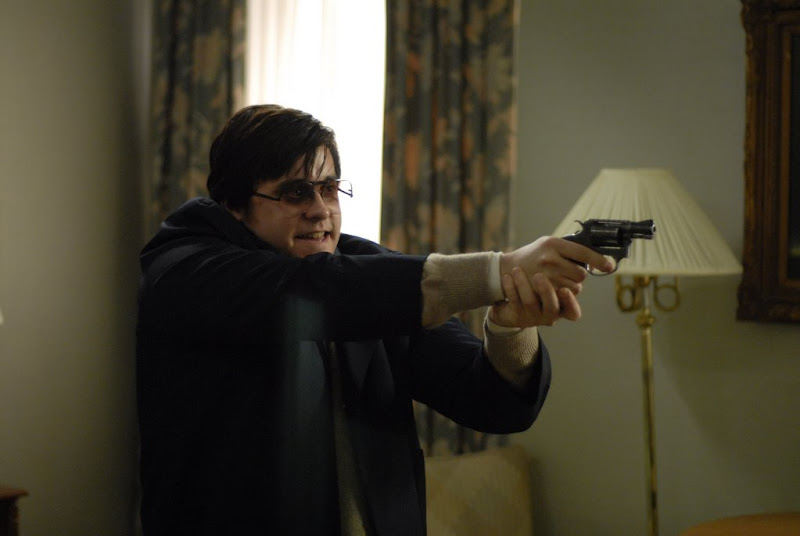
 Fans of John Lennon, myself included, are still saddened by his death on December 8, 1980. How could somebody pull the trigger on a peace loving legend? A new film "Chapter 27" (USA/Canada 2008, 84 min.) tries to revisit the tragedy moment from killer Mark David Chapman's perspective. Unfortunately, the film fails to tell a compelling story about the killer, which only leaves Lennon's fans more agonized.
Putting on 67 lbs and a creepy voice, Jared Leto plays the mentally unstable Mark David Chapman who is from Hawaii with a Southern accent. Chapman is a John Lennon's fan himself and listens to Beatles. He is also obsessed with the novel "The Catcher in the Rye" that ends with Chapter 26. Chapman believes himself to be the novel's character and wants to write the next chapter—Chapter 27, by killing John Lennon. "Chapter 27" chronicles Chapman's last few days before he pulled the trigger. Chapman's constant eerie voiceover reminds us again and again that he is crazy, but provides us little insight about where he was coming from and why he committed the horrific crime. Looking for answers to these questions should be precisely what audiences expect from a film like this. Although Chapman looks and sounds awkward in the film, a girl named Jude, played by Lindsay Lohan, become friend of him quickly while waiting outside John Lennon's apartment for an autograph. I think Lindsay Lohan's character needs a rehab, not for alcohol, but for stupidity.
Noticeably, not a single song by John Lennon is played in the film, although the killer is a big fan of John Lennon. I can imagine why. I don't see anyway the filmmakers can get the right to use John Lennon's songs in a film about John's killer. It's probably equally hard for people who love John to hear mentioning the killer's name, even worse, to listen to his voice, especially when there is not much interesting content in his babbling. "Chapter 27," will open in Bay area theaters on April 18. |
Sunday, April 6, 2008
Calavera Highway
|
"Calavera Highway" (USA 2008, 88 min.) is a new documentary from the Academy Award-nominated director Renee Tajima-Peña.
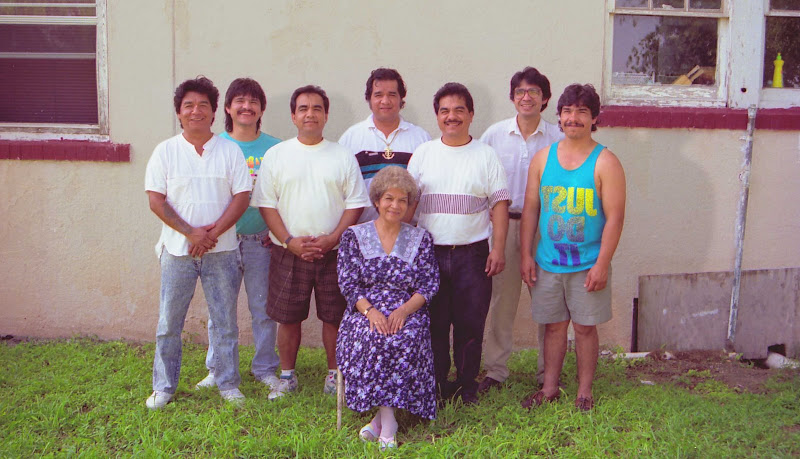
Renee Tajima-Peña's husband Armando Peña grew up in the Rio Grande Valley in Texas, in a family of seven boys. His father Pedro "disappeared" into Mexico when Armando was a baby. His mother Rosa raised the seven boys alone.
After Rosa died of cancer in Los Angeles, Armando and his brother Carlos carry Rosa's ashes back to South Texas. Along the way, the seven sons of the family recount the family history, rediscover the meaning of masculinity and fatherhood, and reconnect with their late father Pedro when they travel to Mexico, where Pedro was born and laid to rest. The story is very personal, yet has its universal aspect dealing with family and parenthood. With often poetic visual and the sometimes insightful narrative, the documentary intimately shares this Mexican-American family's odyssey. "Calavera Highway" will be shown at the 51st San Francisco International Film Festival (SFiFF). |
Labels: SFiFF2008
Saturday, April 5, 2008
Still Life (三峡好人)
 In order to deal with the repeated flooding problems as happening in China right now, Chinese relocate 1.13 million people (almost twice the population in San Francisco) to build the 2309 meter (1.435 miles) long "Three Gorges Dam" (长江三峡大坝).
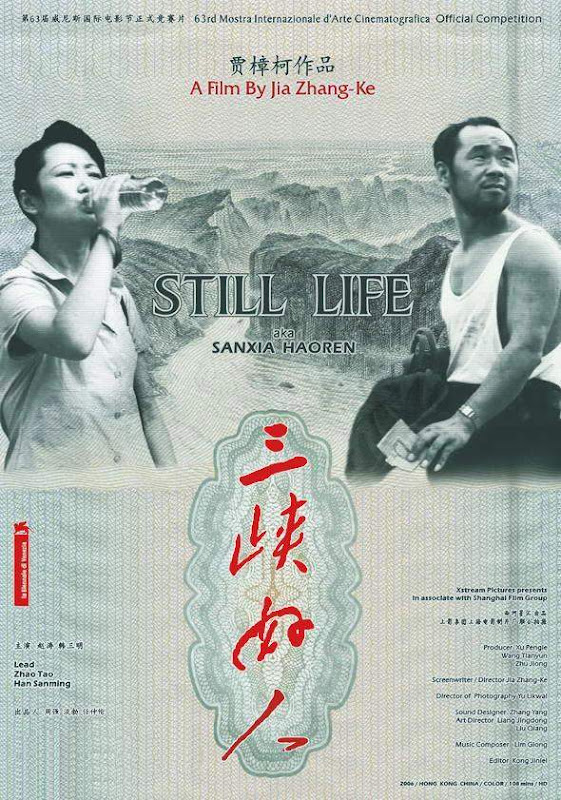
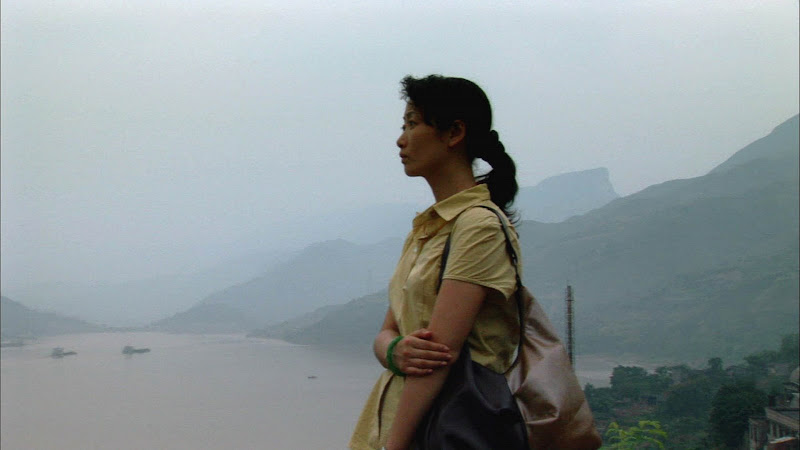
One demolished county to give its way to the Three Gorges Dam is called Fengjie (奉节), which is completely under water by now. It's also the location where director Jia Zhangke (贾樟柯) ("World" (世界) and "Unknown Pleasures" (任逍遥)) shot his new film "Still Life" (三峡好人, China 2006, 108 min.) The film tells stories of two totally unrelated individuals who come to Fengjie to look for people. One is coal miner Han Sanming: searching for her daughter that his ex-wife took with her 16 years ago. The other one is nurse Shen Hong: searching for her husband who has not come home for two years. And there is absolutely no connection between these two stories, except they all happen at the Three Gorges Dam. Also in the film, at the same location, something took off and went into the space -- I am still wondering what that was. As Jia's other films, plots are not as important as the surroundings the director wants to present. Some hate his films, while some others are his cult followers. But even you don't like his films, you probably won't forget images that reflect lives in the world his characters live in. For example, four workers crawl into one bed one by one, shirtless, holding a bowl of noodles. But his unconventional cinema language can also create some communication problems even with the subtitles. In this film, Jia pops on screen with words "cigarette," "liquor," "tea," and "sugar" to divide his film into four segments. Why? And why didn't he use "rice" or "soy sauce?" Well, perhaps only Jia knows. Some feel it's unjust for this film to win the top Golden Lion award last year at the Venice Film Festival. Actually, I wouldn't vote for it either if I were casting a vote. But, what do I know? I have not even seen Three Gorges (三峡), nor stayed at a place for 1.5 Yuan (about $0.2) per night. It's a story about different lives, so called "Still Live."
"Still Life" will be shown at the 51st San Francisco International Film Festival (SFiFF). This review was originally written on July 19, 2007. Reposting for the SFiFF51. |
Labels: SFiFF2008
Secret (不能说的秘密)
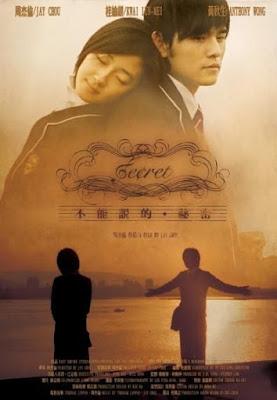 In Asian, young people might not know who Justin Timberlake is, but I bet they all know heartthrob pop star Jay Chou (周杰伦). After his appearance in Zhang Yimou's "Curse of the Golden Flower (满城尽带黄金甲)," his movie carrer began to take off on top of his success in music. But he doesn't stop there. He presents us his directorial debut "Secret (不能说的秘密)" (Taiwan 2007, 101 min.), a lavish looking melodrama about high school romance.
Jay Chou plays Xiang Lun who is a new prestigious student at Tamkang Secondary School studying piano. He meets another piano student Xiao Yu on campus and falls for her, while another girl Qing Yi has a crush on him. Xiao Yu suddenly disappears after a mishap during a date with Xiang Lun. Unable to forget Xiao Yu, Xiang Lun constantly searches for her and for the "secret" melody she played when they first met. The film already sounds like an episode of endless Korean melodrama series. For most part it is, without much dramatic happenings. Chou perhaps also realizes this weakness, so toward the end of the film, the story takes a sharp turn with an unexpected dramatic twist. However, it's a little too late and disconnected from the rest of the film. Playing Xiang Lun, Chou definitely shows his piano training that he began at the age of four. I am also impressed by his skills in the kitchen. I wish I were equally impressed by his film though.
Arguably it's very difficult to figure out the lyrics in Chou's songs by listening to them, but that doesn't bother Chou's mass fan base a bit. Similarly, even "Secret" lacks complex characters and an engrossing story, Chou delights his fans with his impressive production and himself. "Secret (不能说的秘密)" will be shown at the 51st San Francisco International Film Festival (SFiFF). |

Labels: SFiFF2008
Wednesday, April 2, 2008
Secret Sunshine (밀양)
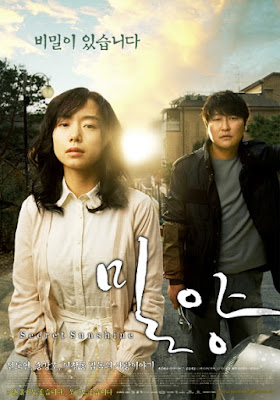 South Korea's entry for Oscar nomination in the Foreign Language Film category in 2007 is "Secret Sunshine (밀양)" (South Korea 2007, 142 min.), a gripping yet unsatisfying drama.
Piano teacher Shin-ae (Jeon Do-yeon) loses her husband in an accident. She and her young son move to Miryang (密陽), her late husband's hometown, to start a new life. Upon arrival, she meets Jong Chan (Song Kang-ho), a local auto shop owner who shows great interest in her. However, the small town new life doesn't play out according to Shin-ae's plan and a terrible tragedy takes place. Shin-ae has to find a way, including religion, to cope with the unbearable pain. I am partial to Korean films because many of them tell very original, fascinating, and unpredictable stories. Although I have no idea what might happen next while a good story is unfolding, one thing I am pretty sure is that it won't be something formulaic like most Hollywood films. That's how I feel when I watch this film. It's so engaging that it's almost frightening to wonder what kinds of twists and turns I might encounter. I don't know where the film is going. Unfortunately, the film goes nowhere meaningful. It fails to deliver after spending all the energy to build the suspense. It stops short on reaching its climax or making a point with its story. The film ends abruptly leaving audiences perplexed without a resolution. The film seems very ambitious because it opens too many interesting and provocative subjects to tight them up at the end.
Although the later half of the film is disappointing, a stunning performance from Jeon Do-yeon (전도연) alone would make "Secret Sunshine" a worth seeing. Her brilliant portrait of a devastated woman won her the Best Actress award at the 2007 Cannes Film Festival. "Secret Sunshine" is like a rare dish that you might not like it for the first try, but you certainly won't forget it easily. |


