Friday, August 22, 2008
Death Race
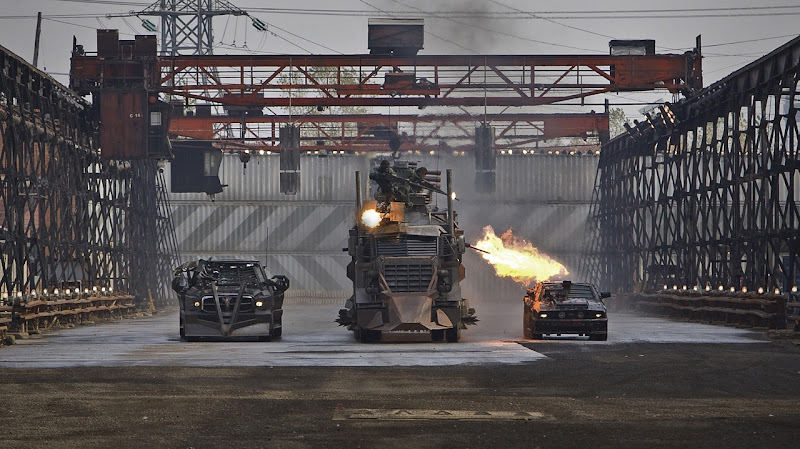
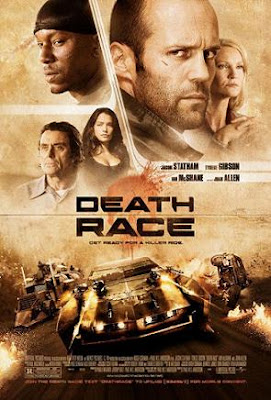 Where should one go to experience car racing, computer game playing, loud music, pretty girls, machine gun shooting, and gruesome killing? Apparently UK director Paul W.S. Anderson's action flick "Death Race" (USA 2008, 89 min.), a remake of "Death Race 2000" (1975), makes a special deliver of a super sized combo with all these ingredients.
A beefy speedway champion Jensen Ames (Jason Statham) is framed for murdering his wife and sent to prison to rot away with other felons. Well, not really. The real reason he is sent to prison is because Hennessey (Joan Allen) wants him to sustain a killing race that is set inside the prison and broadcasted to violence hungry television viewers. In exchange, Hennessey promises Jensen the freedom if he wins the race. It is expected that Jensen is naive enough to believe her and join the violent race. The story begins with a ludicrous logic. It seems that there still have law and order in "post-industrial wasteland of tomorrow," because Jensen has to be framed for murder in order to be locked up. That makes killing sounds like a no-no. Yet, once inside a prison, slaughtering is a game that everyone must play and killing is not only permitted, but the only way to survive. Watching prisoners fight to death is an idea that was tried in "The Condemned" and failed pathetically. "Death Race" seems take that lesson and concentrates on fulfilling violent computer game player's fantasies—let real people play their computer game on a big screen, with real flesh and blood, and real pretty girls—surprisingly wearing seatbelts—sitting next to the race car drivers as decorations. Just like in a computer game, they drive race cars as fast as they can while firing deadliest weapons, and they never worry about the gas price. Exciting? Yes. Loud? You bet. Making any sense? Definitely not.
For computer game addicted teenager boys, they will walk out this film feeling exhilarated. For everyone else, perhaps the only possible way to make sense of this film sometimes in the future is to start playing a computer game now, and make sure that the game is a violent one. "Death Race" opens today in theaters. |


Friday, August 15, 2008
Frozen River
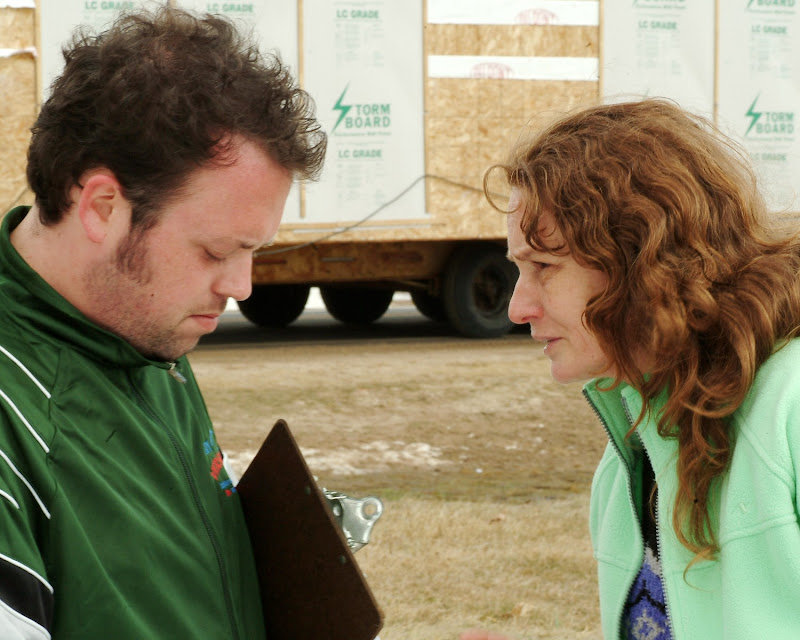
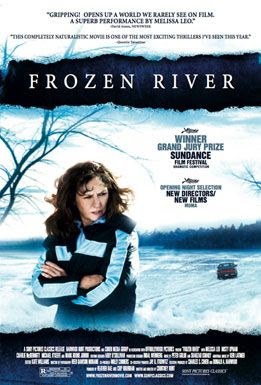 How far is a mother willing to go in order to provide food and shelter for her children? Courtney Hunt's directorial debut "Frozen River" (USA 2008, 97 min.) affectionately tells a compelling story about two women's struggle for survival. It won the Grand Jury Prize for Dramatic Feature at this year's Sundance Film Festival.
Set in upstate New York next to a Mohawk reservation, Ray (Melissa Leo) desperately needs money, so her 15 years old and 5 years old sons can stop eating popcorn for dinner. Her husband addicts to gambling and vanishes with the down payment for their double-wide trailer. While searching for him, Ray meets a woman Lila (Misty Upham) from Mohawk reservation who tries to get her son back to her custody. They team up and begin to smuggle illegal aliens over the frozen river to make quick money, hoping that Ray will get her double-wide trailer and Lila will get her son back. Without any flashback or any fancy special effect, "Frozen River" is engrossing, touching, and precise, with a powerful performance from Melissa Leo. How this film tells the story reminds me Coen brothers' "Fargo," although "Frozen River" is less funny and less bloody, if there is any blood at all. "Frozen River" allows the story takes the course and unfold as it happens; mostly in freezing cold ice and snow, the film's memorable protagonists struggle with money, then get themselves into "situations" they know they should avoid. However, unlike the characters in "Fargo," Ray and Lila smuggle illegal aliens not because of greed, but because of the desperation in taking care of their children and because of love. Although the episode of smuggling of Pakistani couple in the film seems superficial, this is one of those great independent films that we greatly admire their honest effort and solid contents and we tend to forgive their flaws.
"Frozen River" opens on Friday (August 15) in theaters. On Friday, 30 January 2009, "Frozen River" comes to the Opera Plaza in a special return engagement fresh off its Academy Award nominations for Best Actress (Melissa Leo) and Best Original Screenplay. |
Friday, August 8, 2008
Boy A
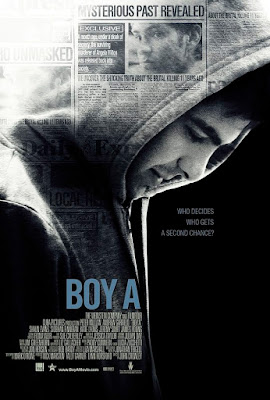 Should a child who committed a crime be given a second chance? Answers might be quite different depending on whom we ask. Based on a novel, a British drama "Boy A" (UK 2007, 100 min.) does not intend to answer this question for the audience. The film focuses on "Boy A"—a name used by the media when reporting his crime. It tells a engrossing story about his struggle to live a second chance. It deals a tragic situation with strong characters, great performance, impressive cinematography, and a heavy heart.
"Boy A" is given a new name Jack Burridge (Andrew Garfield) when he is released after fourteen years in prison for a terrible crime he committed when he was ten years old. With the help from a social worker Terry (Peter Mullan), Jack hopes that he can rebuild a new life. His progress seems promising, as long as he keeps his past a secret. Andrew Garfield's finely calibrated performance as Jack Burridge took this year's British Academy of Film and Television Arts (BAFTA) Best Actor Award. His previous noticeable roles include a smart student of Robert Redford in "Lions for Lambs". In "Boy A," his performance is amazingly mature portraying a shy, troubled, genuine, confused, and gentle young man. The development of the story and the character of Jack are heavily relying on Mr. Garfield's performance, because it is crucial for the audience to develop empathy toward this unfortunate young man. We are force to take a stand between forgiveness and crime punishment, just like many characters in the film have to do the same as well.
In flashback, we learned that Mr. Garfield's character Jack Burridge has a tough childhood to begin with. By the age of ten, he was put away for fourteen years. Without a normal growing up experience, now he is placed back to the society. He is scared, but he seems ready for a second chance. However, the victim's family and the public might not think he deserves one. "Who decided who gets a second chance?"—"Boy A" poses this question to the audience, and I am not sure if I have the answer. |

Friday, August 1, 2008
The Mummy: Tomb of the Dragon Emperor
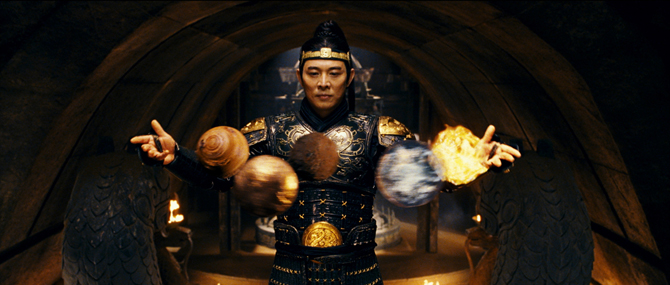
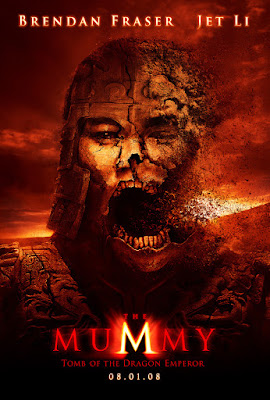 I had to admit—when I walked out the theater after a screening of "The Mummy: Tomb of the Dragon Emperor" (USA 2008, 112 min.) a few days ago, I could not remember the title, except the word "mummy" in it. This film is supposed to be the third installment in the "Mummy" series, despite the fact that there is no mummies in the emperor's tomb, except a Terracotta Army (兵马俑). The pretentious CGI work showing a goofy fight between the Terracotta Army and skeletons cannot save the weak script and thin characters.
The previous installment "The Mummy Returns" (USA 2001) was set in 1933, when archeologist Rick O'Connell (Brendan Fraser) had an eight years old son Alex. Fast forward to 1946 in Shanghai, Alex (Luke Ford), now 21, discovers the tomb of "Emperor Han" (Jet Li). Emperor Han was cursed into a clay statue by Zi Juan (Michelle Yeoh) more than 2000 years ago. If Alex's discovery resurrects Emperor Han and awakes his Terracotta Army, the consequence will be catastrophic, as claimed by the emperor. Rick O'Connell must save the world by bombing the hell out of Emperor Han, because Emperor Han and his Terracotta Army is regarded as a WMD. The plot does not make much sense, because it only serves the purpose of showing off the expensive CGI works, elegant martial arts, loud explosions, and more CGI works. Did I mention CGI already? Even the emperor is given a different name in the film, it is quite obvious that he is modeled after Emperor Qin (秦始皇), who is well known for unifying China, building the Great Wall, and creating a city sized underground Terracotta Army. However, he has never been regarded as "Dragon Emperor." To me, labeling the emperor with the word "dragon" seems a clumsy attempt to infuse Chinese element into this film, because everything else are failing.
Although the story is set 13 years later from the previous film, Brendan Fraser has only aged 7 years (2001-2008) in real life. As a result, it becomes really funny to hear Luke Ford calling Brendan Fraser "dad" when they look like a fraternity brothers. However, "The Mummy: Tomb of the Dragon Emperor" should have no trouble to find at least one fond audience—the President. The film fulfills the fantasy of finding a WMD, bomb the hack of the location, and claim the victor of getting rid of a WMD. Evidently, the President is one step ahead of this film—he bombed Iraq, not China. "The Mummy: Tomb of the Dragon Emperor" opens today in theaters. |