Sunday, April 26, 2009
Every Little Step
 We can all imagine how fierce competitions might be among actors trying to get a role in a Broadway production. Every winner is followed by hundreds if not thousands of losers. Although almost every audition process is brutal and "not for the weak of heart," unlike TV shows such as American Idol, we normally do not know the often deeply emotional behind-the-scene stories about those auditionees.
In 1975, when Michael Bennett brought audionees' personal stories into a Broadway musical "A Chorus Line," it won nine Tony Awards and became one of the longest running musicals on Broadway. Three decades later, "A Chorus Line" is revived on Broadway. The audition process not only once again echoes the musical's story, it also produces a touching and endearing documentary "Every Little Step" (USA 2008 | 96 min.). The film pays tributes to artists of many generations. The casting team consists of A Chorus Line's original co-choreographer Bob Avian and original cast members Donna McKechnie and Baayork Lee. Their task is to select 19 actors out of over 3000 auditionees. The film captures auditionees' heartfelt journeys and explores A Chorus Line's legacy. The filmmakers bring us inside the audition studio and also those actors' lives through their observant and affectionate lenses. The film turns the harsh audition process into a suspensive dramatic tale about the dedication and struggle from these talented artists. Even we might have our own picks after each audition, all actors, especially those who do not get the parts, earn our respect and admiration.
During a scene in A Chorus Line, a gay youth character Paul gives a monologue describing the moment when his parents come to see his performance. When Jason Tam auditions for Paul, his powerful deliverance not only brings me into tears, it also breaks down the casting team captured by the film, even they have heard the same lines for thousands of times. If anybody is not moved by Jason Tam's monologue, I will refund your ticket myself. Regardless whether you like musical or not and whether you have seen A Chorus Line or not, this terrific documentary will inspire you as well as entertain you. "Every Little Step" will be shown at the 52nd San Francisco International Film Festival on Sunday, Apr 26, 9:30pm at Castro Theater. "Every Little Step" opens on Friday, May 8th at Bay Area Theater.
|

Labels: SFiFF2009


Thursday, April 23, 2009
The 52nd San Francisco International Film Festival - Part 3
|
Continue on PART 1 and PART 2 of my list of films that I am looking forward to at the 52nd San Francisco International Film Festival (SFiFF52), April 23 - May 7:
|


Labels: SFiFF2009
Wednesday, April 22, 2009
The 52nd San Francisco International Film Festival - Part 2
|
Continue on PART 1 of my list of films that I am looking forward to at the 52nd San Francisco International Film Festival (SFiFF52), April 23 - May 7:
|


Labels: SFiFF2009
Monday, April 20, 2009
The 52nd San Francisco International Film Festival - Part 1
|
Every spring, San Francisco's Japantown is the hot spot to be. Tens of thousands come to Japantown to celebrate the Cherry Blossom Festival, and also come to attend the longest-running film festival in the Americas — the San Francisco International Film Festival (SFiFF).
With more than 150 films from more than 50 countries, the 52nd San Francisco International Film Festival (SFiFF52) will take place April 23 - May 7 at Sundance Kabuki Theater, Castro Theater, Landmark's Clay Theater, and other venues. As always, this year's program is full of excitements. It contains a wide spectrum of recent world cinema as well as a few retrospective programs. Regardless one's taste in films, everybody should be able to find something that is familiar and delightful. In addition, people have plenty to choose from at the festival if in the mood of experiencing something new and challenging. Here is a list of films that I am looking forward to at SFiFF52.
|

Labels: SFiFF2009
Friday, April 10, 2009
Gigantic
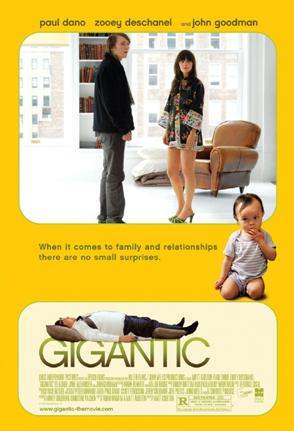 Director/co-writer Matt Aselton's feature debut "Gigantic" (USA 2008 | 98 min.) is a quirky delightful treat for those who are in the mood for some serious giggling.
28-year-old Brian Weathersby (Paul Dano) sells high-end Swedish mattress while pursing his "lifelong" dream — adopting a Chinese baby. After art collector Al Lolly (John Goodman) comes to the store to buy a mattress for his back problem, Brian meets Al's daughter Harriet Lolly, or Happy. While Brian is romantically involved with Happy, he has to constantly fight off a mysterious homeless guy who tries to kill him. Actually the film's plot is not important. The most entertaining aspect about this film is the witty and humorous dialogue, and these verbal exchanges reveal the fascinating relationships among these characters. This is a film one must watch several times in order to catch all the lines, because many of the conversations will not be heard due to the giggling in the audience, especially both Brian and Happy always speak softly in the film. The uniformly strong performances from an ensemble cast deliver many funny lines brilliantly. Paul Dano completely vanishes into a quiet Brian from the charismatic priest in "There Will Be Blood." Edward Asner hilariously steals many scenes in the film playing Brian's 80-year-old father.
However, I am not very fond of the subplot of the crazy homeless character — not because of its relevance to the main story, but because he didn't say a word in the film. After all, the dialogue is the gem of the film that is worth of listening and that is funny. Of course not all of the characters have to speak in order to be funny. For example, those masseuses do not say a word either, but how can anybody keep a straight face while watching them working? "Gigantic" opens on Friday, April 10 at Landmark's Lumiere Theatre in San Francisco, Landmark's Shattuck Cinema in Berkeley, and Camera 12 in San Jose.
FILMMAKER IN PERSON: Director and co-writer Matt Aselton will speak at Lumiere Theatre in San Francisco on Friday, April 10 at 7:00pm & 9:40pm shows, and Saturday, April 11 at Shattuck in Berkeley at 5:00pm & 7:25pm shows.
|

Thursday, April 9, 2009
Artemisia (艾草)
 Although Chiang Hsiu Chiung (姜秀瓊)
might be recognized for her Golden
Horse Award nominated performance as the middle sister
in Edward
Yang's (film ) epic "A Bright
Summer Day"
(牯嶺街少年殺人事件),
most of her works have been behind the camera.
Although Chiang Hsiu Chiung (姜秀瓊)
might be recognized for her Golden
Horse Award nominated performance as the middle sister
in Edward
Yang's (film ) epic "A Bright
Summer Day"
(牯嶺街少年殺人事件),
most of her works have been behind the camera.
Some of her works are with renowned directors Edward Yang (楊德昌) and Hou Hsiao-hsien (侯孝賢). She is the assistant director in Edward Yang's "Yi Yi: A One and a Two" (一一). She also worked in Hou Hsiao-hsien's films such as "Flowers of Shanghai" (海上花) and "Millennium Mambo" (千禧曼波).
With that exceptional resume, Chiang Hsiu Chiung's feature directorial debut "Artemisia" (艾草 | Taiwan 2008 | in Mandarin | 85 min.) is nothing short of excellence. The film is an affectional and beautiful portrait of a loving mother Ai-chao who struggles to cope with her family's affairs that reflect the changing society in Taiwan.
Ai-chao (艾草) means Artemisia. It's also the name of this film's protagonist — a 58-year-old Taiwanese woman. When Ai-chao was young, without her mother's approval, she married to her mainland born husband who was 20 years her senior. After her husband died 20 years ago, she raised her son and her daughter by herself. Now, not only her children have grown up, the social norm in Taiwan has also changed. It's Ai-chao's turn to face the reality in her family affairs. Despite the conflicts and gaps in generations and culture, the bond and love in a family ultimately prevail.
This deeply affectionate and heartwarming film embraces family, love, and the turbulent journey of understanding and accepting each other in a changing society.

Either coming from her own or influenced by directors Edward Yang and Hou Hsiao-Hsien, the film definitely has a resemblance in the storytelling style to films by Yang and Hou. The film's engrossing story and lively characters are naturally developed and effortlessly win over our hearts.
"Artemisia" will be shown at the 52nd San Francisco International Film Festival on Sunday, Apr 26 at 9:15pm, Sunday, May 3 at 12:45pm, and Thursday, May 7 at 8:30pm at Kabuki Theater. Director Chiang Hsiu-chiung will be in person for Q&A at these screenings.
"Artemisia" is the winner of the Golden Gate Awards in the Television Narrative Long Form category at this year's San Francisco International Film Festival.
Labels: SFiFF2009
Wednesday, April 1, 2009
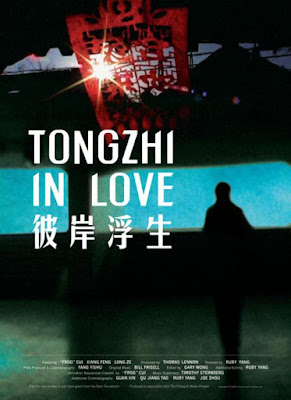
Tongzhi in Love (彼岸浮生)
 The director Ruby Yang's
(杨紫烨) heartbreaking documentary
about devastating HIV/AIDS victims in
China, "The Blood of
Yingzhou District
(颖州的孩子)" won the
2007 Academy Award for Documentary Short Subject. Following
that film's success, Ruby Yang moved to China and worked on
many projects related to public health, including
anti-smoking and AIDS awareness campaigns in
China. Recently, Ruby Yang and Thomas
Lennon created public service announcements (PSAs)
called "Life Is Too Good" to promote safe sex.
The director Ruby Yang's
(杨紫烨) heartbreaking documentary
about devastating HIV/AIDS victims in
China, "The Blood of
Yingzhou District
(颖州的孩子)" won the
2007 Academy Award for Documentary Short Subject. Following
that film's success, Ruby Yang moved to China and worked on
many projects related to public health, including
anti-smoking and AIDS awareness campaigns in
China. Recently, Ruby Yang and Thomas
Lennon created public service announcements (PSAs)
called "Life Is Too Good" to promote safe sex.
Continuing on her worthy contributions, Ruby Yang's new film "Tongzhi in Love" (彼岸浮生 | China 2008 | in Mandarin | 30 min.) is probably the first documentary about gays in China. It tells the stories about gay men's double lives in modern China—on one hand they live in freer city gay life, and on the other hand they stay in the closet bearing the responsibility to produce an heir because often they are the only child to their parents.
The word Tongzi (同志) originally means "comrade" in Chinese. However, since the early 90s, Tongzhi has become a synonym for "gay" in Chinese in the LGBTQ community, and nowadays it is a widely used term referring to gay people by the public in China.
Riding the waves of the rapid social and economic progress in China, many gays begin to enjoy a much more tolerate atmosphere in China and to taste their newly found gay freedom in big cities such as Beijing and Chengdu. However, most of them cannot come out to their parents, and they still live a double life. That's because besides the conservative views toward gays in China, they also face the immense pressure uniquely in the Chinese culture based on Confucian (儒家) teaching.
One of the most prominent Confucian scholar Mencius (孟軻) once said:
"Among the three major offenses against filial piety, not producing an heir is the worst." (不孝有三无后为大.)
More than two thousand years later, more than a billion Chinese people still take Mencius's words close to their hearts. Obviously, it creates bigger challenge for gay men, because many of them are the only child in a family due to the One Child Policy started in 1980 in China.

This documentary investigates this complex scenario through three young gay men's personal stories. Via candid testimonies and lively interviews, these three characters share their opinions, their struggles, their sacrifices, their sorrows, and most importantly, their love for their parents. The film captures the heavy burden in these young men's minds and shows us how they walk the thin line between pursuing happiness and pleasing their parents, especially when the two cannot go hand in hand.
These Tongzhi are in love, but not without pain.
"Tongzhi in Love (彼岸浮生)" will be shown with "The Blood of Yingzhou District (颖州的孩子)" at Frameline 32.
Labels: SFiFF2009

