Tuesday, May 20, 2008
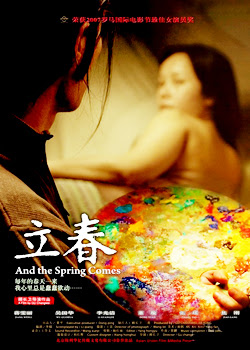
And the Spring Comes (立春)
|
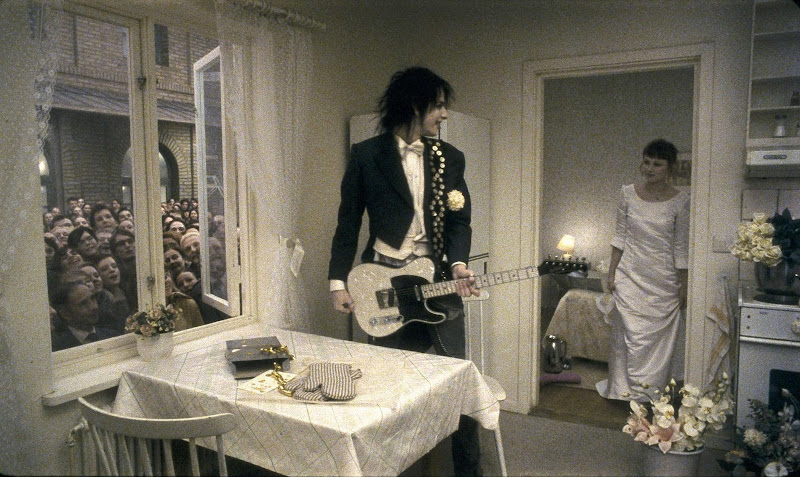
After built an impressive resume as a cinematographer for top directors such as Zhang Yimou (张艺谋), Chen Kaige (陈凯歌), and Robert Altman, in 2005 Gu Changwei (顾长卫) delivered his stunning directorial debut "Peacock (孔雀)." The film took the Silver Bear award at the Berlin International Film Festival.
At the end of "Peacock," the voiceover from the younger brother says: "我恍惚记得,爸爸走那天,很快就是农历立春了。
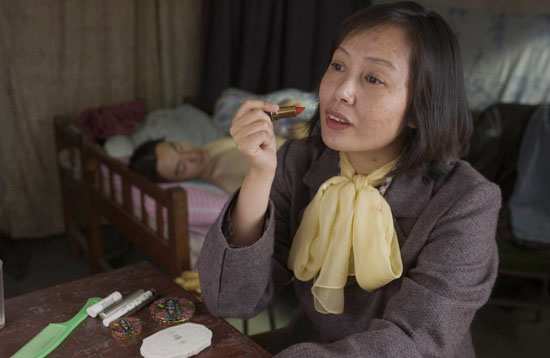
Set in a small town near Baotou, Wang Cailing is a vocal teacher who has an magnificent voice and a big dream—to be an opera (Italian Opera, not Beijing Opera) singer at the National Opera House. She is not dreaming alone: she meets a young man who wants to be a China's Vincent van Gogh, a gay ballet dancer who pasts his prime, and many other artist misfits. All of them struggle not only to realize their dreams, but more pressingly, to get accepted and understood by the society, which means to survive. The film is a tribute to those artists who are trapped in the hush reality but keep their hopes alive. Despite the repeated setbacks, they continue to long for a new life, a new love, and a new world, no matter what it takes. Their experiences are often heartbroken, but never fail to inspire. Jiang Wenli (蒋雯丽), director Gu's wife in real life, strikingly played the misfortunate, unattractive, and trying protagonist Wang Cailing. Jiang put on 15 lbs and disappeared completely in her character both emotionally and physically. Her outstanding performance earned her the Best Actress award at the Rome Film Festival in 2007, when the film was premiered.
Many member of the production team of "And the Spring Comes" are from Gu's first film "Peacock." For example, Li Qiang (李樯) wrote the eloquent script and Dou Peng (窦鹏) composed the fantastic music. In the film, Jiang's character Wang Chailing wonders philosophically: 每年春天一来,实际上也不意味着什么 The audiences must be wondering as well: Will love and hope that millions of Wang Chailing have been dreaming about come true next spring? Is something going to happen to them or are they going to miss out again? However, one thing will be certain: they will not stop dreaming. |


Saturday, May 17, 2008
Dalai Lama Renaissance
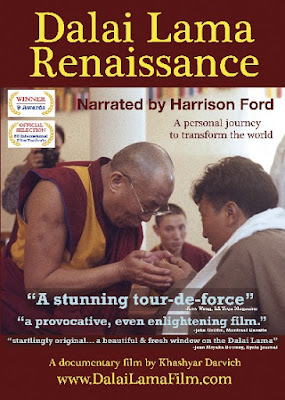 Tenzin Gyatso, the 14th Dalai Lama, perhaps is one of the most recognizable and most controversial figures today. Who is he? What is his teaching? What is his view on the current issues we are facing in the world?
Although the documentary "Dalai Lama Renaissance" (USA 2007, 81 min.) does not answer all of these questions, it does give an up close profile to this extraordinary and complex individual. In 1999, 40 westerners with different religion background, disciplines, and of course, point of views, travel to India to meet the Dalai Lama at his residence. Their goal is to discuss many problems in the world we are facing today and gain perspectives through the direct dialogue with the Dalai Lama. Before they begin a discussion with the Dalai Lama during a limited time each day, these westerns debate and discuss among themselves trying to come up some kind of consensus about how to present their views to the Dalai Lama and how to proceed the dialogue. This film captures their spiritual journey, as well the Dalai Lama's teaching. In places like Germany, the Dalai Lama's undeniable charisma and likeable personality make himself more popular than the pope as a religious leader, and a respectable spiritual inspiration to many. Many footage of his teaching in this film effectively shows the Dalai Lama's passion for humanity as well as his wit and insight toward spirituality. He tells his audience to open heart and embrace the spirituality inside ourselves with or without any religious faith; and to achieve the inner peace within ourselves. It is indeed inspiring and thought provoking. It is also very interesting to observe how the 40 western participants react and interpret the Dalai Lama's teaching, and how naive some of them are by expecting that the Dalai Lama will give them solutions to the problems in the world. Many of the participants express themselves and their rewarding experience eloquently. Some of the participants obviously have the intention of using this meeting to get a vindication on their own political agenda from the Dalai Lama. Some others simply expose themselves for how ignorant and close minded they are even after the teaching from the Dalai Lama. Understandably, the filmmaker expresses his own point of view about the history and politics in Tibet, without necessarily reflecting the actual Tibetan history. To portrait the Dalai Lama as a victim of the Chinese government is anything but the truth. That's the tricky point when it comes to understand the Dalai Lama's role. The Dalai Lama is an almighty figure when he comes to be a religious and a humanitarian leader. He would have been embraced by the Chinese government if he dedicates himself to that role, which inspires millions of people around the world. However, he is also a politician, especially when he presents himself to the Chinese government and the Chinese people. By playing both roles, the Dalai Lama is able to mobilize the western media in his support to deal with the Chinese government, because to the westerners, he appears to be a religious and a spiritual leader. As a consequence, he becomes ambiguous and perplex when it comes to sensitive issues such as how to deal with the Chinese government. This dilemma shows dramatically in the film when an anti-Chinese government participant ask the Dalai Lama specifically if the Dalai Lama would approve an economical sanction against China over the issue of Tibet. The Dalai Lama first expresses his concern that such action will harm the welfare of the Chinese people, including Tibetan people. He emphasizes that people should not take any action to harm the Chinese people. Therefore, the logical answer one might think is that he does not approve such an action, right? Yet, he refuses to give an straight answer to that simple question. He winkes with a smile. What he preaches does not apply here any more. Strange? Not for a politician. Isn't the idea of "separation of church and state" absolutely brilliant? "Dalai Lama Renaissance" is an interesting documentary paying tribute to a fascinating individual. It opens on May 23 at the Roxie Theater in San Francisco. |
Wednesday, May 14, 2008
The Machine Girl (片腕マシンガール)
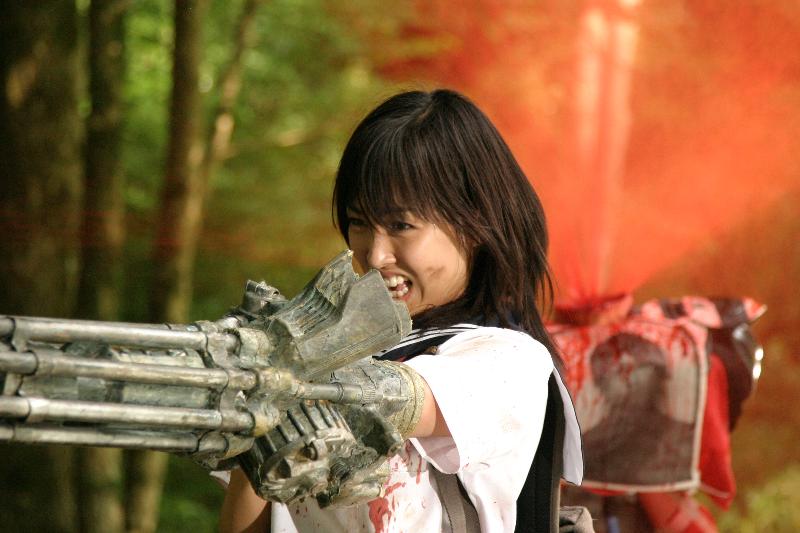
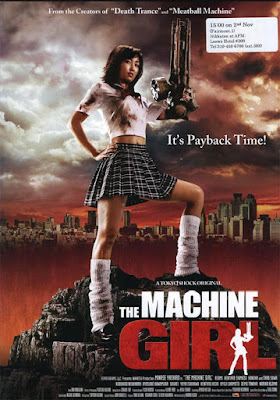 How should a teenager revenge after being bullied at school? How about let the bullies water your lawn? With their blood, that is. At least that's how it turns out in this blood spraying, body parts flying, kung fu fighting, over-the-top Japanese film "The Machine Girl" (片腕マシンガール, Japan/USA 2007, 96 min.).
In "The Machine Girl," a teenager girl Ami loses her little brother to school bullies. During her quest of revenge, she loses one arm. However, she replaces it with a machine gun that is more powerful than a lawn mower. She vigorously continues her battles with her enemies, of course, with a lot blood shed. Although this is that kind of movies that the audiences are not supposed to reasoning the details, the storyline in this film is surprisingly engaging. Despite the fact that these characters seem more real in computer games than in real life, the film doesn't create one-dimensional cartoon characters, All the characters in this film seem to forget to take their high blood pressure medicines—when their body parts get cut, which happen quite often, their blood spray out stronger than a firefighter's water hose. And, it keeps going. If we put these guys on a lawn, the lawn will be always green. I mean, red. The film is so over the top that it's very funny. How can I not to laugh when I see a giant "Arm Tempura" (a deep fried arm coated with flour batter)?
I normally don't fancy blood genre, but this film is "bloody" fun, indeed. "The Machine Girl," will be screened at the San Francisco's 5th "Another Hole in the Head Film Festival". According to the press conference, "with more than 30 films from six counties, Another Hole in the Head Film Festival offers two weeks of bloodsucking parasitic monsters, angry ghosts, genetic manipulation, maniacs, killer hair, assassins, stalkers, psychos, zombies, aliens, and more macabre mayhem than you can shake a stick at, aim a pistol at, or blast a flamethrower towards." The 5th San Francisco "Another Hole in the Head Film Festival" will run June 5-18, 2008 at Roxie Theater. |
Labels: Another Hole In the Head Festival 08
Thursday, May 8, 2008
Fados
|
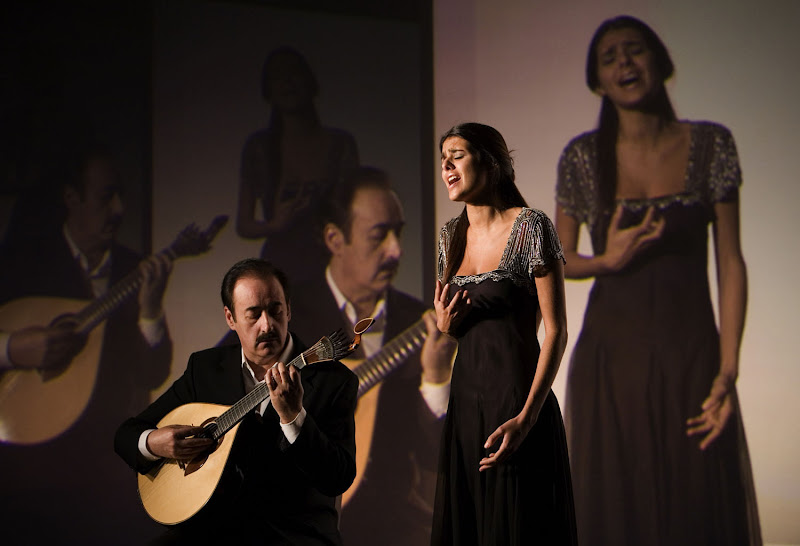
If you don't know what fado is, after the musical documentary "Fados" (Portugal/Spain 2007, 93 min.), you will fall in love with fado. From acclaimed Spanish director Carlos Saura, unlike any other documentary, this film does not have any talking heads, nor voice over narratives, nor story lines. It simply puts a few most fantastic Fado pieces together, accompany with splendid choreography and carefully arranged color and background. The film lets fado speak for itself. And it works, wonderfully. I began to learn about fado when I visited Lisboa last year. This film not only brings back to the memory about the voices at the local cafes, it also brings back the fond memory about the beautiful city, Lisboa. Always with their eyes closed, fado singers passionately covey sentimental tales with their unforgettable voices. The fado music is deeply moving and extremely sad, most of the time. Just by listening to them, like many others in the theater, I instantly have tears in my eyes. Fado is charged with extremely rich and powerful emotions that affect its listeners, as well as its performers.
This film might not be as conventional as most documentaries you have seen, just like fado is not as most other music you have heard either. However, the film will profoundly touch you, because fado will. "Fados" was shown at the 51st San Francisco International Film Festival (SFiFF). |
Labels: SFiFF2008
Thursday, May 1, 2008
Dark Matter (流星)
 "Dark Matter" ("流星" USA 2007, 86 min.), staring Liu Ye (刘烨) and Meryl Streep opens on Friday, May 2nd in bay area theaters.
Based on a true event, it tells a compelling story about a bright young graduate student Liu Xing, played by Liu Ye. Liu Xing comes to the US from China to study physics in a university. He believes that America is the land where his talent can be recognized, his dream can be realized, and his scientific ideas can be explored. However, not only he has to struggle to adapt to the reality due to culture clashes, he also has to make sense of the academic world when he conducts his research on "dark matter." Perhaps due to the fact that director Chen Shi-zheng (陈士爭) is an opera director, the music selections in this film really stand out to me. They are deeply moving and very effective on building up the emotion and add more layers to the story. They also bring nostalgia of the 90s for newly arrived Chinese students in the US. Besides Meryl Streep always being terrific, the performance from those supporting actors who play Chinese students are very impressive. They vividly portrait those young student's experience living in a culture shock environment. However, it seems to me that the writer of the film is not very familiar with the scientific subject, in this case, the physics. The dialogue on those subject is very odd. And it will never happen in any department in a university to have a professor arguing with a secretary about a student's academic study. Also, I don't get the metaphor of the four out of the five elements (wood 木, fire 火, earth 土, metal 金, and water 水) used in the film, with fire (火) is missing. This film is particularly interesting to me on another personal level. I was actually just 1 hour and half away (driving) when the actual event happened in 1991 (do NOT click on that link BEFORE seeing the movie, because it will contain spoiler). Years later, that event has not been forgotten. "Dark Matter" was the closing night film at the 25th San Francisco International Asian American Film Festival |
Halftime at the 51st SFiFF
|
The 51st San Francisco International Film Festival (SFiFF51) is now on its half way mark. I have seen some great films, as well as some disappointing ones. That's actually a great fun part of attending a film festival—I get a chance to see some films that otherwise I would not skipped. Besides, this might be the only chance to see some of these films on a big screen.
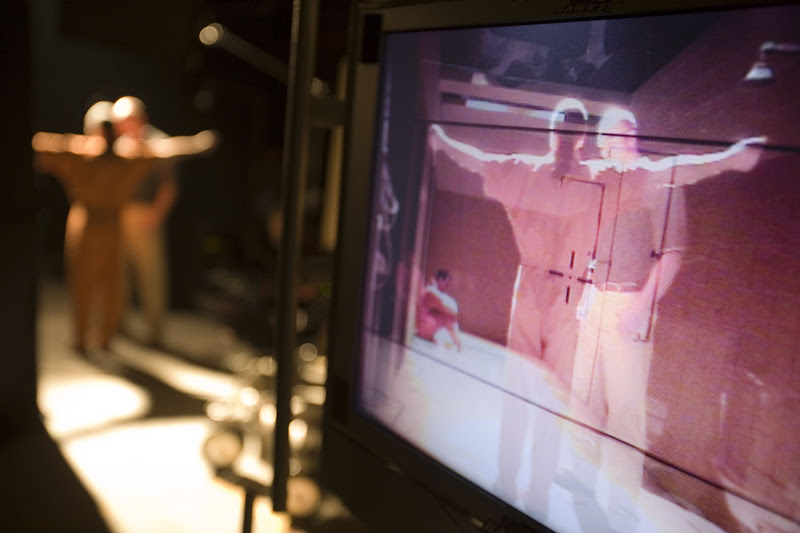
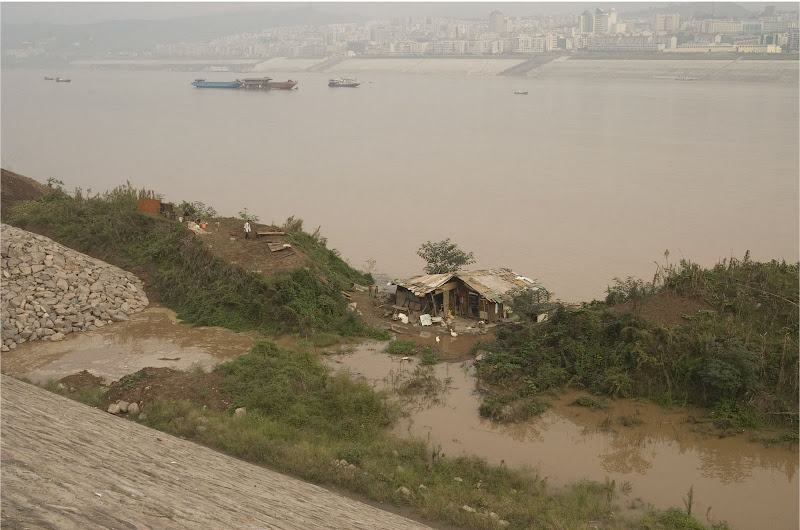
Because many films have a "hold review" request, the following is a brief recap about some of the films I have seen so far at the festival. More to come later.
|

Labels: SFiFF2008

