Friday, May 20, 2011
13 Assassins (十三人の刺客)
 Despite the uniquely shaved hairstyle, samurai
give me the impression for being brave and brutal at the same
time, and they treat their dignity and reputation as
important as their lives. They often draw their swords to kill either
the enemy, or themselves. They regard death as honor and
have no fear of it.
Despite the uniquely shaved hairstyle, samurai
give me the impression for being brave and brutal at the same
time, and they treat their dignity and reputation as
important as their lives. They often draw their swords to kill either
the enemy, or themselves. They regard death as honor and
have no fear of it.
These characteristics of samurai are vindicated from the opening scene to its last frame in prolific Japanese director Takashi Miike's (三池 崇史) splendid and bloody film "13 Assassins" (十三人の刺客 | Japan 2010 | in Japanese | 126 min.). This remake of a 1963 Japanese film is a samurai movie that is filled with fierce fight, river of blood, and plenty rolling heads, and it is certainly not a period drama about Japanese history or politics. Set in 1844, the end of Edo period, shougun's brutal brother, Lord Naritsugu (Gorô Inagaki), is about to seize more power and bring more misery to the people. In order to stop Naritsugu, a veteran samurai Shinzaemon Shimada (Kôji Yakusho) chooses eleven more samurai to carry out the assassination of Naritsugu, even he is protected by a well-trained army with hundreds of soldiers. They all understand that obviously this is a suicide mission, but all of them are determined to finish this last job with their lives. On their way to the location where they ambush Naritugu, they encounter a villager who is familiar with surroundings, and he is quickly recruited to be the 13th assassins. After they carefully convert a village to a battle ground, the rest is history.
Besides numerous swords are stuck to the ground like grass, a large amount of explosive is also used in the battle. Otherwise, how can thirteen men confront hundreds of soldiers? If assassination is the ultimate goal, anything goes for a kill. Although I can still see traces from Takashi Miike's previous films such as "Audition" (a female victim of Naritugu surely looks familiar), "13 Assassins" is a delicately crafted epic samurai film that has little resemblance to his previous films. The almost never ending battle is surprisingly engaging, remarkably detail oriented, and definitely entertaining. However, besides few leading characters, it is hard to distinguish the other assassins, especially when they wear similar clothes and have the same haircut. Let's just call them samurai. "13 Assassins," a Magnet Releasing release, opens on Friday, May 20, 2011 at Bay Area theaters. It was also shown at the 54th San Francisco International Film Festival.
|

Labels: SFiFF2011


Friday, May 6, 2011
Incendies
 The good, bad, and ugly about religion, as well as the politics around
it, have been debated since as early as the religions are
created. Those debates often involve wars and killing of
human lives. I agree most points made in
Christopher
Hitchens's controversial book
"God
Is Not Great: How Religion Poisons Everything," and I always
fantasize a world that only exists in the lyrics of
John
Lennon's "Imagine."
The good, bad, and ugly about religion, as well as the politics around
it, have been debated since as early as the religions are
created. Those debates often involve wars and killing of
human lives. I agree most points made in
Christopher
Hitchens's controversial book
"God
Is Not Great: How Religion Poisons Everything," and I always
fantasize a world that only exists in the lyrics of
John
Lennon's "Imagine."
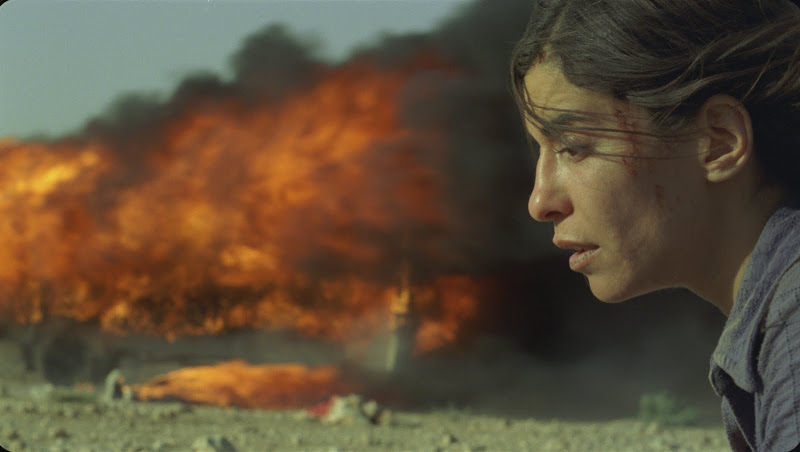
Therefore, it is natural for me to resonate with the tragic story when I am only half way into Canadian director Denis Villeneuve's powerful Oscar nominated film "Incendies" (Canada 2010 | in French | 130 min.). However, by the end of the film, the killing and hatred initiated by religion recede to the background, and an extraordinary woman's personal tragedy takes the center stage, with an operatic gravity that can be matched by the scale in Shakespeare's plays. The film begins with the death of a Mid-east woman Nawal Marwan (Lubna Azabal) who lives in Canada with her twin children Jeanne (Mélissa Désormeaux-Poulin) and Simon (Maxim Gaudette). Jean Lebel (Rémy Girard), the executor of Nawal's will, hands each of the twins a sealed envelop— Nawal asks Jeanne to deliver the letter to her father she has never met, and Nawal asks Simon to deliver the letter to his brother who never exists to him. The journey of seeking their father and brother not only unveils Nawal's haunting past, but also allows the twins to truly know their mother for the first time.
Like Wajdi Mouawad's play which the film is based on, director Denis Villeneuve deliberately makes the story's Mid-east location ambiguous, in order to make the film apolitical. That appears to be an artificial stroke for avoiding the obvious unrest in the Mid-east today. However, on the other hand, it makes another point more prominent—just like the blood shed and war in the film, many political turmoil and conflicts around the world today (and in the past) are rooted in people's hatred toward others who have different religious believes. That echoes back to the title of Christopher Hitchens's book, on a very personal level in Nawal's tragic story. Without a doubt, this gripping film should have won the Oscar for Best Foreign Language Film. "Incendies," a Sony Pictures Classics release, opens on Friday, May 6, 2011 at Bay Area theaters. It was also shown at the 54th San Francisco International Film Festival.
|
Labels: SFiFF2011
Friday, April 29, 2011
Let the Wind Carry Me (乘著光影旅行)
 If you were asked who
Lee Ping-bin (Mark Lee 李屏賓) is, I doubt that
many of you would know. Although you might have
seen many Lee Ping-bin's work through over 50 films he shot behind the
camera—you rarely have the chance to see him in front of the camera.
If you were asked who
Lee Ping-bin (Mark Lee 李屏賓) is, I doubt that
many of you would know. Although you might have
seen many Lee Ping-bin's work through over 50 films he shot behind the
camera—you rarely have the chance to see him in front of the camera.
Director Chiang Hsiu-chiung (姜秀瓊, whose "Artemisia 艾草" is one of my top-ten films in 2009) and co-director Kwan Pun-leung (關本良) bring this award-winning Taiwan-born cinematographer Lee Ping-bin to the focus in an intimate documentary "Let the Wind Carry Me" (乘著光影旅行 | Taiwan 2010 | in Chinese | 88 min.). It often intriguers me how distinct visuals in films such as the following have a lasting impression on me: "In the Mood for Love" (花樣年華), "Flight of the Red Balloon" (Le voyage du ballon rouge), "The Sun Also Rises" (太陽照常升起), "Café Lumière" (珈琲時光), "Air Doll" (空気人形), "Three Times" (最好的時光)... The list goes on. Besides these remarkable films are all made by acclaimed auteurs, what else are these film in common? They are all shot by Lee Ping-bin (Mark Lee 李屏賓). He has an exquisite talent to tell a story by his unique visual style for his subject. While this documentary affirms that statement by showing large amount of footage from Lee's work and from many interviews with renowned directors, it also provides a platform for soft-spoken, low-key, modest Lee to speak candidly about his work, his philosophy, his family, and his life in general.
The film pays tribute to a talent artist, Lee Ping-bin, not only for his exceptional work, but for his inspiring integrity and charming character during the quest of pursuing his art.
|

Labels: SFiFF2011
The Journals of Musan (무산일기)
 It seems that if you are born in North Korean, you are doomed. No
matter what you do, your future looks grim, if you have one. If the
news media reports are accurate, you will starve to death if you stay
in North Korea. However, if you are lucky enough to escape to South
Korea (where else?), you will be discriminated and you will encounter
extreme hardship to survive. If there is one happy-ending North Korean
defector story, it is yet to be told.
It seems that if you are born in North Korean, you are doomed. No
matter what you do, your future looks grim, if you have one. If the
news media reports are accurate, you will starve to death if you stay
in North Korea. However, if you are lucky enough to escape to South
Korea (where else?), you will be discriminated and you will encounter
extreme hardship to survive. If there is one happy-ending North Korean
defector story, it is yet to be told.
Adding to a steam of recent films on the misery experience of North Korean defectors, for example "Dance Town" (댄스타운 | South Korea 2010), write/director/actor Park Jung-bum's feature directorial debut "The Journals of Musan" (무산일기 | South Korea 2010 | in Korea | 127 min.) tells another poignant heartbreaking story, which you might have heard it in a slightly different version before. Jeon Seung-chul (played by the director Park Jung-bum) is from Musan (무산군) in North Korea. After he defects to South Korea, he lives with anther street-smart defector Kyung-chul (Jin Yonguk) in a tiny shabby apartment. Because of the discrimination and prejudice against North Korean detectors, as well as the practical obstacles, it is extremely hard for Seung-chul to find a stable and well paying job. He struggles to make ends meet by posting bills on street walls and working at a karaoke nightclub, while being harassed repeatedly by local gangsters. The only comfort moment he can find is when he goes to the church watching the beautiful Sook-young (Kang Eunjin) singing, or when he is holding a stray dog he finds on the street.
While the characters are well acted and the story is convincingly told, the film only goes skin deep at this complex issue of the treatment toward North Korean defectors in South Korea. Instead of letting us understand Seung-chul's character better, the film only paints a sketch of another pitiful soul that is born to the wrong place. Like other films on this subject, this film repeats the similar message that has been sent to North Koreans like Seung-chul many times before—we know how hard life is back there in North Korean, but for you, it doesn't get any better if you come to South Korean either. Just take a look at Seung-chul. You are done.
|

Labels: SFiFF2011
Thursday, April 28, 2011
End of Animal (짐승의 끝)
 Like best buddies, horror and sci-fi genres tend to hang out together
in a film. It is logical, because we as human have an instinct fear
toward unknown, while unknown is what sci-fi deals the best—it
only uses imagination. Writer/director Jo Sung-hee
(조성희)
composes his imagination in his impressive directorial
debut
"End of Animal"
(짐승의 끝 | South Korea 2010 | in Korean |
114 min.).
This gripping film never stops bringing in more intriguing moments
that make your head spin and give you goose bumps.
Like best buddies, horror and sci-fi genres tend to hang out together
in a film. It is logical, because we as human have an instinct fear
toward unknown, while unknown is what sci-fi deals the best—it
only uses imagination. Writer/director Jo Sung-hee
(조성희)
composes his imagination in his impressive directorial
debut
"End of Animal"
(짐승의 끝 | South Korea 2010 | in Korean |
114 min.).
This gripping film never stops bringing in more intriguing moments
that make your head spin and give you goose bumps.
A pregnant young woman Sun-yeong (Lee Min-ji) takes a taxi to her mom's place for the delivery. The cab is stopped by a hooded young man (Park Hae-il) who wants to share the ride. But he does not appear to be a random stranger, because he seems to know both the taxi driver (Kim Young-ho) and Sun-yeong very well, especially about their secrets. He claims that "the wind from the sun will blow out the light, and the angels with sharp teeth will come down to earth" when he finishes his count down. Sure enough, everything stops with a white bang. When Sun-yeong wakes up, she finds herself in an apocalyptic environment. She wanders into an empty nearby village, desperately hoping to find a phone to contact her mother. Nothing works. No one is around, until a lost boy (Park Sae-jong) and a villager on a bicycle (Yoo Sung-mok) show up. However, they are not really the ones she hopes who can help her to get away from the mysterious man in the hood and to get out this chilling mess. Everything only gets worse.
Jo Sung-hee effectively crafts engaging and terrifying scenes one after another to keep you on your toes. He seems interested more in displaying the dramatic tension among these characters during an arduous situation, than explaining why certain things happen and how. Perhaps in an apocalyptic stage, reasoning is not what people concern the most. Sun-yeong, and everyone else in the film, is obsessed about going to a rest area to make a contact to the outside world. However, if nothings works in the village, how can they be so sure that the rest area is business as usual? Nobody knows. Anywhere else probably looks better than this terrifying domain that Jo Sung-Hee creates with his imagination.
|

Labels: SFiFF2011
Saturday, April 23, 2011
The High Life (寻欢作乐)
 Nobody can ignore the economical boom in China over the last few
decades. A huge army of super rich and middle-class is born in China. Last
year, China became the second largest economy in the world, only
behind the Unite States. Yet, underneath those glamorous achievements,
there are millions of Chinese people who are left behind. They
struggle to make ends meet and desperately searching for a way to
survive.
Nobody can ignore the economical boom in China over the last few
decades. A huge army of super rich and middle-class is born in China. Last
year, China became the second largest economy in the world, only
behind the Unite States. Yet, underneath those glamorous achievements,
there are millions of Chinese people who are left behind. They
struggle to make ends meet and desperately searching for a way to
survive.
These are the people who have been the subjects of Chinese director Zhao Dayong's (赵大勇) documentaries. He continues to tell their stories in his narrative feature debut "The High Life" (寻欢作乐 | China 2010 | in Chinese | 96 min.), a film that is certainly not singing a harmony note in the chorus of celebrating China's economical progress. Jian Ming (Liu Yanfei) is a small time crook who sets up a job referring stand on a street corner for new comers in Guangzhou. Instead of introducing jobs, he collects the money and posts their pictures on his bedroom wall for his own amusement, when he is not singing opera on top of the roof to escape the reality. However, when he meets Xiao Ya, he falls for her and actually lands her a job at a hair salon. That job doesn't go well when a local gangster shows up at the salon.
Then, unexpectedly, the film abandons all these characters, but turns its (very expensive) lenses to a railroad police, Dian Qiu (Shen Shaoqiu), who enjoys hear inmates reading "trash poetry" as shown in the opening of the film. You can come up your own explanation about the sudden switch of film's protagonists and story line. I believe the filmmaker is determined to use this real life "trash poet" Shen Shaoqiu 沈绍裘 (see his blog: 典裘沽酒) to shout out his anger and despair. If nothing else, its shocking value fits the bill. Here is an example of anti-culture and anti-establishment "trash poetry" by this real life railroad police Shen Shaoqiu when he refers to one of the most prominent figure in Chinese literature Lu Xun (鲁迅):
"It must be said, Sir, with your cock last century, After all, the police's life is not that much different from Jian Ming's fate, perhaps the only difference is that he writes "poetically."
|

Labels: SFiFF2011
Hospitalité (歓待)
 The Japanese are well known for living with their etiquette and tight
space. However, the Japanese's xenophobia tendency perhaps is less
obvious. Writer/director
Koji
Fukada's (深田晃司) offbeat and hilarious
comedy "Hospitalité"
(歓待 | Japan 2010 | in Japanese | 96 min.)
presents these Japanese traits with plenty fun and entertainment.
The Japanese are well known for living with their etiquette and tight
space. However, the Japanese's xenophobia tendency perhaps is less
obvious. Writer/director
Koji
Fukada's (深田晃司) offbeat and hilarious
comedy "Hospitalité"
(歓待 | Japan 2010 | in Japanese | 96 min.)
presents these Japanese traits with plenty fun and entertainment.
Mikio Kobayashi (Kenji Yamauchi) operates his family printing company downstairs in his small apartment next to the Sumida River in Tokyo. Upstairs, he lives with his young wife Natsuko (Kiki Sugino), his young daughter Eriko (Eriko Ono) from previous marriage, and his divorced sister Seiko (Kumi Hyôdô). Outside the apartment (sometimes inside), folks from the neighborhood watch group keep an eye on outsiders. One day, a smooth talking, humble, yet mysterious Kagawa Hanataro (Kanji Furutachi) appears. Not only he quickly lands himself a job working for Mikio in the printing company, he also moves in, with his Brazilian wife Annabelle (Bryerly Long). Mikio and Natsuko politely accept the move. Little do they know, this is just the beginning of seemingly never ending home invasion in this tiny little apartment.
The film's laugh-out-loud comical moments are always generated by terrific performance and brilliant setup of amusing situations. The more absurd a scene gets, the funnier it becomes in this film. You are busy on laughing and you have no time to think if what happens on the screen can actually really happen in real life. Although the story is set in Tokyo, most the scenes are inside the tiny apartment home, away from the metropolitan hubbub. I find that setting makes this film even more enjoyable and delightful, as if the story is in any small town in Japan. Like its poise, polite, and funny characters, the film unfolds the story gracefully, even the story cannot be more chaotic. Koji Fukada (深田晃司) is a young director's name that you should look out in the future.
|

Labels: SFiFF2011
Friday, April 22, 2011
Hahaha (하하하)
 Based on films directed by Korean auteur
Hong Sang-soo
(홍상수) so far, I can safely come up two
conclusions: he is obsessed about exploring the courtship of men
toward women, and he loves to see his characters drinking. He
frequently puts the word "woman" in his films' titles. For example,
"Woman on the
Beach" (해변의 여인),
"Woman Is the Future of
Man" (여자는 남자의
미래다), and
"Virgin Stripped Bare by
Her Bachelors" (오! 수정)—that
"virgin" refers to a woman. As for drinking, can anybody even count
how many drinking scenes in his films? Although his newest film
continues to tell a story about the courtship over drinks, the title
is a quite original and modern (like a text message or a Facebook
update):
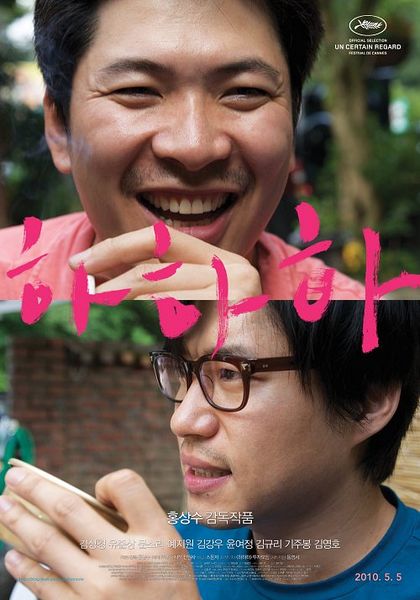
"Hahaha"
(하하하 | South Korea 2010 | in Korea | 115
min.). The film is just like its title—unusual, lighthearted,
funny, and hahaha.
Based on films directed by Korean auteur
Hong Sang-soo
(홍상수) so far, I can safely come up two
conclusions: he is obsessed about exploring the courtship of men
toward women, and he loves to see his characters drinking. He
frequently puts the word "woman" in his films' titles. For example,
"Woman on the
Beach" (해변의 여인),
"Woman Is the Future of
Man" (여자는 남자의
미래다), and
"Virgin Stripped Bare by
Her Bachelors" (오! 수정)—that
"virgin" refers to a woman. As for drinking, can anybody even count
how many drinking scenes in his films? Although his newest film
continues to tell a story about the courtship over drinks, the title
is a quite original and modern (like a text message or a Facebook
update):
"Hahaha"
(하하하 | South Korea 2010 | in Korea | 115
min.). The film is just like its title—unusual, lighthearted,
funny, and hahaha.
In the film, film director (the character, not Hong) Jo Moon-kyeong (Kim Sang-kyung) meets up his film critic friend Bang Jong-sik (Yu Jun-Sang) in Tongyeong before Moon-kyeong moves to Canada. Over drinks, they talk about their past happy moments in Tongyeong. Whenever a happy moment is flashed back, they cheer and have a sip. Of course, these moments almost always involve relationships with women, including a tour guide Wang Seong-ok (Moon So-Ri) who is also an amateur poet.
When more and more moments are revealed, and more and more drinking cups are emptied, the audience begins to realize that these two friends may be telling the same moments without even knowing it.

The twisted plot unfolds playfully and effortlessly, even you may wonder from time to time if you are the one who are having too much to drink, instead of the characters. The film certainly has Hong's signature style and his everlasting theme: courtship with women.
In the end, we can sense that Hong is the one who has the most fun making this film. He is the one laughing while many of us might be pondering what kind of joke he has been artfully telling in this film.

Labels: SFiFF2011

