Friday, June 27, 2008
Wanted
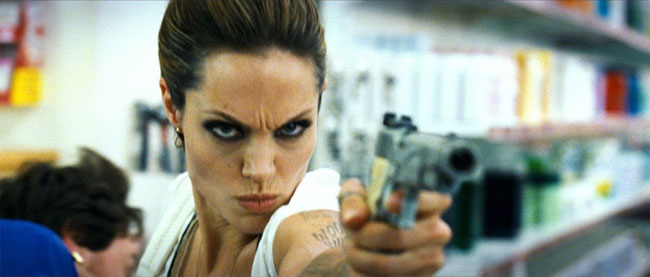
A broke office clerk Wesley Gibson (James McAvoy) has special physical ability that he is not aware himself. Reluctantly, he gets selected into this fraternity of assassins, headed by Sloan (Morgan Freeman). To transform Wesley from a Dilbert into a professional assassin, Cox (Angelina Jolie) and other old fraternity members brutally train Wesley during the hazing process—they basically torture him into pieces. Soon enough, Wesley goes on his assassination assignments, and discovers the shocking truth about the fraternity. These characters seem all have an incredible ability to endure physical trauma and to recover from any injury in no time. All of them seem less complex than those weapons they use, and their minds can be easily manipulated. However, these characters are not what this exhilarating film is about. This film is about hair raising actions, the shock-and-awe fighting choreography, incredible creative imaginations, and the beautiful race car driving, machine gun shooting, tattoo covering, ass kicking Angelina Jolie. No matter what character she plays in a movie, people will see Angelina Jolie, period. So the film does not bother to spend much effort on her character. Instead, it focuses on her actions, and how she kills her targets. Nobody can deny that the action sequences are crafted together brilliantly in this film.
After the film, you will know how to get on a missed train—fasten your seat belt in Angelina Jolie's car. She can get you there, and it will be a fantastic amazing ride! |



Sunday, June 22, 2008
Tru Loved
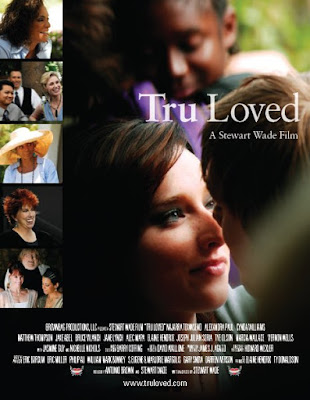
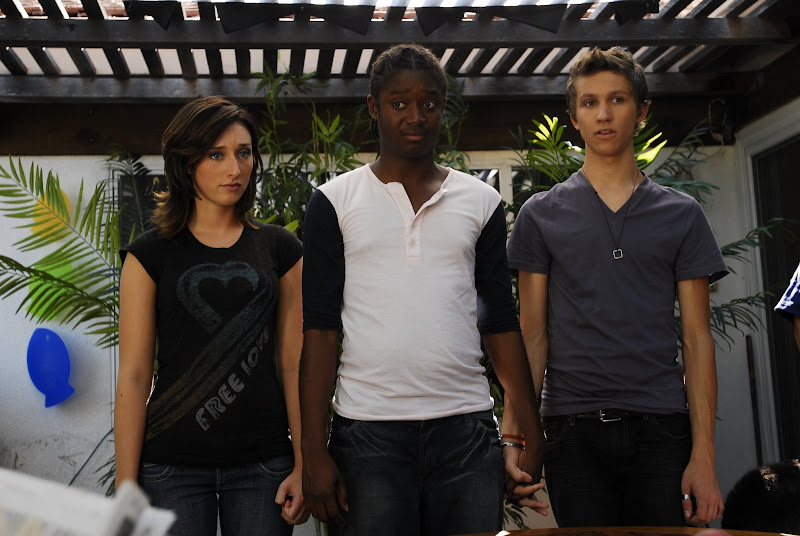
Sixteen years old Tru (Najarra Townsend) moves to suburban Southern California with her two lesbian moms, away from her two gay dads living in San Francisco. She becomes an instant outcast in her new high school, where she meets a closeted gay football player Lo (Matthew Thompson). Fed up by the homophobia at school and the drama for being the cover for Lo at school, Tru decides to form a Gay-Straight Alliance club at her high school. The GSA clubs not only causes a big stir at school, including the mid of her closeted teacher (Alec Mapa), it also connects Tru with a handsome charming Trevor (Jake Abel), who is raised by his gay uncle (Bruce Vilanch). It's amazing how Tru's life is surrounded by gay people, even she no longer lives in San Francisco; and everyone seems gay friendly except the homophobic football coach at school. Luckily, the strong performance and the engaging story line leave the audiences little time to wonder if this setting exists in real life. With an extraordinary ensemble casts, the film delivers positive messages without preaching. Thanks to the terrific writing, the film creates a few memorable and convincing characters, and they speak witty, hilarious words without sounding cliché. It seems that the film can go wrong at so many places while the story is unfolding. Yet, the film miraculously dances its way out of a landmine field, not only without many scratches, it also holds its head up high. It stands out to become an excellent coming out film for teenager and adult film goers, gay or straight, to enjoy.
"Tru Loved" will be screened at Frameline 32. |
Labels: Frameline 2008
Monday, June 16, 2008
Tongzhi in Love (彼岸浮生)
 The director Ruby Yang's
(杨紫烨) heartbreaking documentary
about devastating HIV/AIDS victims in
China, "The Blood of
Yingzhou District
(颖州的孩子)" won the
2007 Academy Award for Documentary Short Subject. Following
that film's success, Ruby Yang moved to China and worked on
many projects related to public health, including
anti-smoking and AIDS awareness campaigns in
China. Recently, Ruby Yang and Thomas
Lennon created public service announcements (PSAs)
called "Life Is Too Good" to promote safe sex.
The director Ruby Yang's
(杨紫烨) heartbreaking documentary
about devastating HIV/AIDS victims in
China, "The Blood of
Yingzhou District
(颖州的孩子)" won the
2007 Academy Award for Documentary Short Subject. Following
that film's success, Ruby Yang moved to China and worked on
many projects related to public health, including
anti-smoking and AIDS awareness campaigns in
China. Recently, Ruby Yang and Thomas
Lennon created public service announcements (PSAs)
called "Life Is Too Good" to promote safe sex.
Continuing on her worthy contributions, Ruby Yang's new film "Tongzhi in Love" (彼岸浮生 | China 2008 | in Mandarin | 30 min.) is probably the first documentary about gays in China. It tells the stories about gay men's double lives in modern China—on one hand they live in freer city gay life, and on the other hand they stay in the closet bearing the responsibility to produce an heir because often they are the only child to their parents.
The word Tongzi (同志) originally means "comrade" in Chinese. However, since the early 90s, Tongzhi has become a synonym for "gay" in Chinese in the LGBTQ community, and nowadays it is a widely used term referring to gay people by the public in China.
Riding the waves of the rapid social and economic progress in China, many gays begin to enjoy a much more tolerate atmosphere in China and to taste their newly found gay freedom in big cities such as Beijing and Chengdu. However, most of them cannot come out to their parents, and they still live a double life. That's because besides the conservative views toward gays in China, they also face the immense pressure uniquely in the Chinese culture based on Confucian (儒家) teaching.
One of the most prominent Confucian scholar Mencius (孟軻) once said:
"Among the three major offenses against filial piety, not producing an heir is the worst." (不孝有三无后为大.)
More than two thousand years later, more than a billion Chinese people still take Mencius's words close to their hearts. Obviously, it creates bigger challenge for gay men, because many of them are the only child in a family due to the One Child Policy started in 1980 in China.

This documentary investigates this complex scenario through three young gay men's personal stories. Via candid testimonies and lively interviews, these three characters share their opinions, their struggles, their sacrifices, their sorrows, and most importantly, their love for their parents. The film captures the heavy burden in these young men's minds and shows us how they walk the thin line between pursuing happiness and pleasing their parents, especially when the two cannot go hand in hand.
These Tongzhi are in love, but not without pain.
"Tongzhi in Love (彼岸浮生)" will be shown with "The Blood of Yingzhou District (颖州的孩子)" at Frameline 32.
Labels: Frameline 2008
Sunday, June 15, 2008
The Edge of Heaven (Auf der anderen Seite)
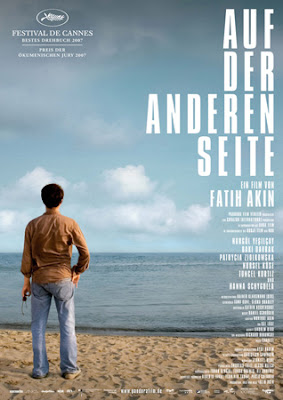
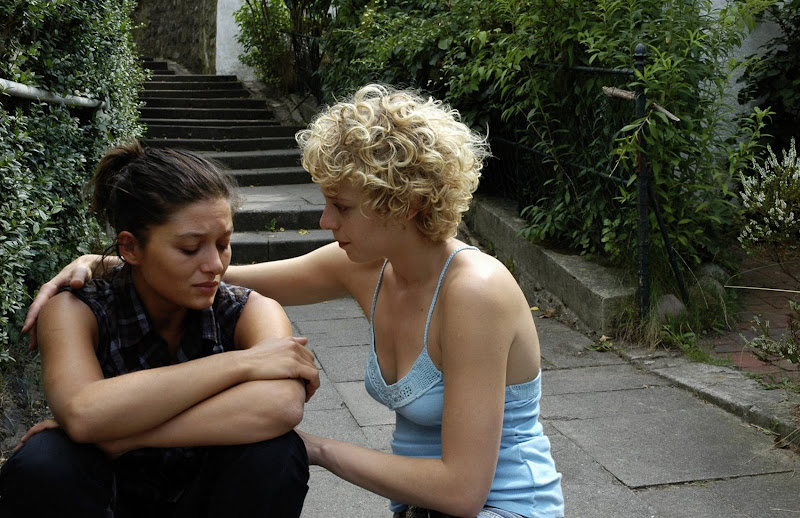
Superbly written and directed by Turkish German director Fatih Akın, "The Edge of Heaven" tells a compelling story about love, hope, loss, grief, and forgiveness. Turkish immigrant Nejat teaches at a German university and lives with his widower father Ali. Ali meets a Turkish born prostitute Yeter and invites her to move in with them. Yeter supports her daughter Ayten who studies in Turkey by sending back money to her. A series of events send Nejat to Turkey searching for Yeter's daughter Ayten, while Ayten comes to Germany searching for her mother Yeter. Ayten finds help from a German student Lotte and falls in love with her while Nejat's search continues. These characters constantly come across each other's lives without knowing it. They keep up their hopes and dreams, deal with their losses and grief, and search for reconciliation and forgiveness. This film is precisely and efficiently constructed. Its storytelling is amazingly effective. One of my favorite scenes is when a coffin in and out a Turkish Airline airplane. It carries tremendous amount of emotion without a single word.
I am not surprised that the film won the best screenplay award at last year's Cannes Film Festival. Some film writers seem lazy to me when they take shortcuts with their plots. For example, they arrange their characters to run into each other in a crowd of thousands of people, or on a street in a city like New York or Paris. That doesn't happen in this film. Quite contrary, characters in this film seem always miss each other. There are so many moments that they could have solved the puzzle, but with one small simple mishap, they miss again. This is one of the most superb films at Frameline 32. Note: This review was originally written last year. Repost for Frameline 32. |
Labels: Frameline 2008
Fairytale of Kathmandu
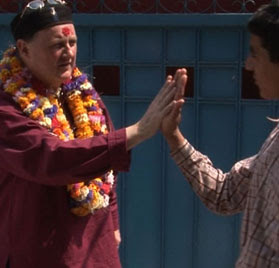 "Fairytale of Kathmandu" (Northern Ireland/Nepal 2007, 60 min.) is an interesting documentary about a gay Irish poet Cathal Ó Searcaigh's annual trip to Nepal.
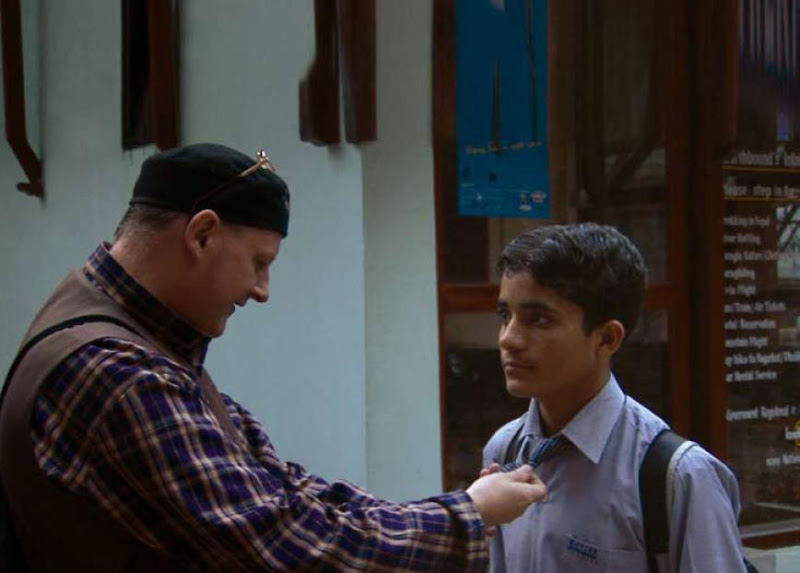
Perhaps everybody have heard "There are something can't buy, for everything else, ..." However, try tell that to a gay Irish poet Cathal Ó Searcaigh. With money in his pocket, and probably a MasterCard as well, Searcaigh travels to Nepal every year, and he can get boys as young as 16 years old to have sex with him. For him, there is nothing money can't buy. Director Neasa Ní Chianáin was invited to join celebrated Cathal Ó Searcaigh traveling to Nepal to make a documentary about Searcaigh's spiritual journey and his generous support to the poor people living there. However, after she observes that young boys are in and out Searcaigh's bedroom, after they were given gifts and "scholarships" for college, Chianáin begins to make a film that tells a complete different story from what it was originally planned. Is Cathal Ó Searcaigh a generous person who gives financial support to those poor boys so they can attend school? Or is he a sex tourist and take advantage of his economical status upon those young boys? The answer is quite obvious to everybody, except Searcaigh himself, who denies that he gives those boy gifts because he wants to have sex with them. He does not think he is buying these boys; he believes that he is helping them out and doing them a favor. That makes him even worse than those Western sex tourists floating around in Asian countries. At least those sex predators are straightforward with their intention. But Searcaigh wants to present himself as a savor, if not a saint, to those boys and to the poor people in Nepal, and he regards his relationships with these young boys to be his inspiration of his work.
"Fairytale of Kathmandu" is a very sad and disturbing documentary to watch, but it tells a story that must be told. This film will be screened at Frameline 32. |
Labels: Frameline 2008
Friday, June 13, 2008
The Incredible Hulk
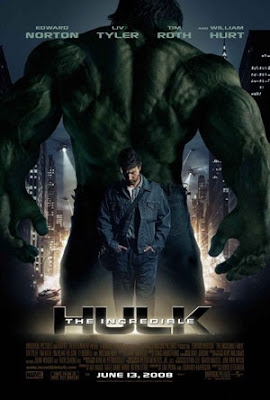 If the memory of King Kong starts to fade in one's mind, a new action packed, fast paced, superhero themed blockbuster "The Incredible Hulk" (USA 2008, 114 min.) brings all the excitement back, featuring a giant green angry man, the Hulk, who is probably more powerful than his distant cousin King Kong.
Comic character Hulk is Dr. Bruce Banner, who becomes a green monster with powerful strength after an experiment went bad, or well, depending on who you ask. In 2003, director Ang Lee's film "Hulk" brought this character to the big screen, but was poorly received by Hulk's fans. This new promising "The Incredible Hulk" will change that, and it will very likely start a new wave of Hulk frenzy. In "The Incredible Hulk", Edward Norton plays Bruce Banner, a.k.a. Hulk. His blood has been altered so that when he becomes angry, he explodes into bullet proof Hulk, who has extremely powerful strength. He tries to find a cure to return back to normal, but he is sought by a US military general who wants to turn him into a weapon. However, during the process of catching Hulk, the general creates another monster that perhaps only Hulk has the ability to control. A battle is guaranteed to happen, in New York City. Where else?
Edward Norton is the perfect guy to play Hulk, because he is always sad, if not angry. Besides his smirk in "Primal Fear," can anybody recall a smile from any roles he ever played? In order to transfer Bruce Banner into the green giant Hulk, all he needs to do is to get his heart beat faster. Getting angry does the trick perfectly. Like most superhero flick, the plot is somewhat formulaic. However, the energy and the dazzling special effects in this film will keep the audiences engaged and entertained. They will beg for a sequel, or sequels. Even at the end of the film, another superhero walks into a bar, thinking about teaming up with Hulk. Let the speculation about the sequel begin when one walks out "The Incredible Hulk." Incredible, indeed. |

Friday, June 6, 2008
Stuck
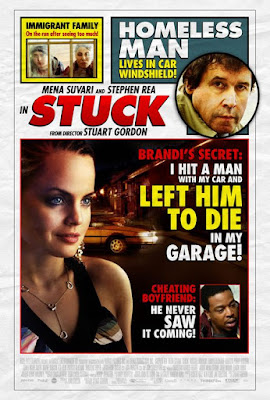 After screened at the San Francisco IndieFest earlier this year, "Stuck" (USA 2007, 94 min.) brings blood, thrill, and twisted humor back to Bay area theaters.
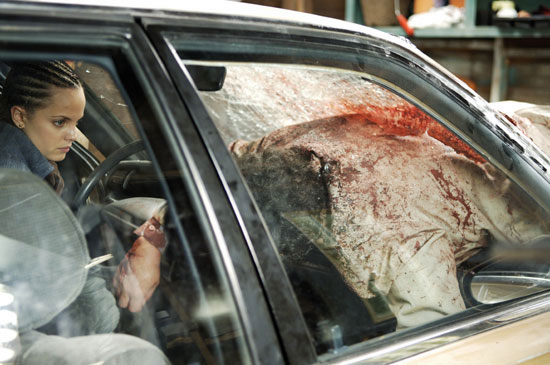
Mena Suvari plays Brandi, a nurse at a retirement home who is about to get promoted. But on the way home after an outing with her drug dealer boyfriend, she hits homeless man Tom, played by Stephen Rea. However, she does not stop or call 911. She continues to drive, back into her garage. Hit and run? Not really, because Tom is still with her—he is "stuck" on her windshield. Whether Tom will survive is anybody's guess, but one thing is certain: there will be blood. Nobody would really expect these characters to be realistic no matter how the story claims to be based on a true event. However, these actors put in their best effort trying to make them convincing, thus make the film really funny. How could a caring nurse be so cold blooded and continues her driving when somebody stuck in her windshield? Somehow, she thinks that as long as nobody sees the man on her windshield, her problem will all go away and her promotion will not be affected. Evidently, that plot is just an vehicle for the film to deliver the real gig—testing how strong audiences' stomach can be. The film deliberately shows the glory bloody scene to make one moan. It knows that one might have been covering eyes. No problem! It takes its time on a scene so that by the time the eyes are open again, they won't miss anything. That makes the film bloody funny.
Although this film is not a cup of tea (or blood) for everybody, it will definitely find its followers who are delighted by its twisted humor. No one can understand what Brandi is thinking when she is doing everything to cover up the accident in order to be able to go back cleaning the feces soiled sheets. However, if she didn't do what she does, the film would not have existed. |
Labels: SFIndie08
Monday, June 2, 2008
Frameline 32—San Francisco International Gay and Lesbian Film Festival
|
The San Francisco International LGBT Film Festival—Frameline—is not only a film festival, it's a huge party.
It's no coincident that the festival is held every year overlapping with the annual San Francisco Pride Parade & Celebration. It makes a big difference when a screening is accompanied by hundreds, if not thousands, gay and lesbians. The atmosphere in the crowd can turn a mediocre film into a cheering campy hit. Therefore, it's natural for this year's Frameline 32 to have a slogan:
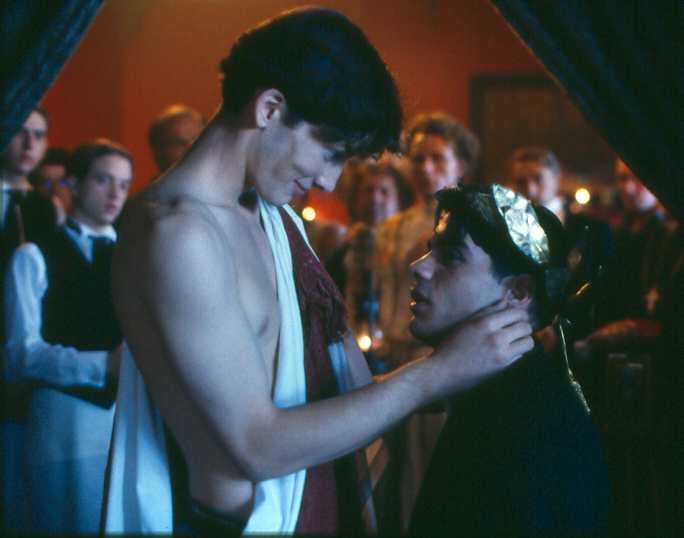
"I Like to Watch Movies with My Community." With 103 programs, including 88 feature films and 148 shorts from 36 countries, Frameline 32 runs June 19-29 at Castro Theater, Roxie Theater, Victoria Theater, and Rialto Cinemas Elmwood in Berkeley. I consider "Lilies" (Les feluettes, Canada 1996, 95 min.) to be one of the best gay and lesbian films ever made. This year's "Michael Lumpkin Retrospective" provides a great opportunity to see this film one more time on the big screen.
Superbly written and directed by Turkish German director Fatih Akın, "The Edge of Heaven" (Auf der anderen Seite, Germany 2007, 122 min.) tells a compelling story about love, hope, loss, grief, and forgiveness. (See my review written last year.) It was the opening night film at the 13th annual Berlin and Beyond Film Festival earlier this year. Festival goers are fortunate to be able to see "The Edge of Heaven" before its theatrical releases.
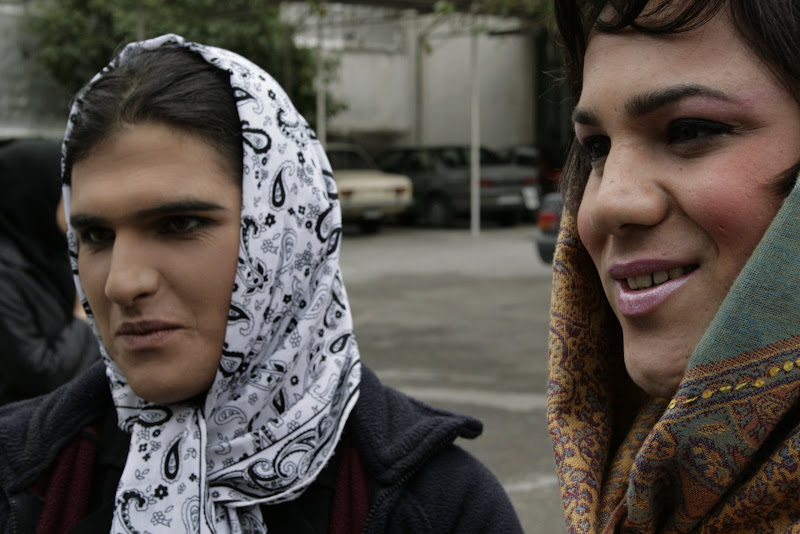
An engrossing documentary "Be Like Others" (Iran/Canada/UK/USA 2008, 74 min.) explores the emotional and physical turmoil of transsexuals in Iran. Homosexual is illegal in Iran. However, the Iranian government is totally supportive about sex-reassignment operations, because once a man is changed to a woman, there won't have any homosexual. The problem is solved. This fascinating documentary won the 2008 Teddy Jury Award at the Berlin International Film Festival.
Every year at Frameline, festival goers always enjoy seeing "Fun in Boys' Shorts" and "Fun In Girls' Shorts" (no pun intended). However, this year, "From Singapore to Seoul and L.A. - Gay Asian Shorts" is a short program that will entertain the audiences even more than boys' and girls' shorts.
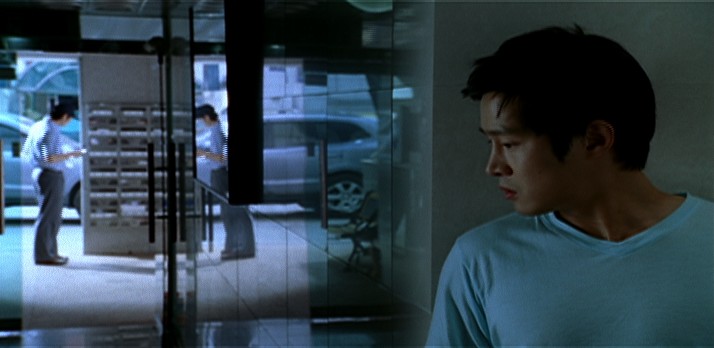
After the charming "Police Box" (SFIAAFF25, Frameline31), director Josh Kim returns to the festival with his new short film "The Postcard" (USA 2008, 15 Min.). It tells a story about getting the postman's attention by writing messages on a postcard. In fact, "The Postcard" is so delightful that it is programmed into two short programs: "From Singapore to Seoul and L.A. - Gay Asian Shorts" and "Worldly Affairs." Among Frameline32's films, there are 27 films that "examine queer life through an Asian/Pacific Islander lens." They provide an excellent opportunity for film goers to experience the Asian gay and lesbian cinema.
|





Labels: Frameline 2008

