Tuesday, July 28, 2009
Happily Ever After (自虐の詩)
 Does unconditional love exist? If so, can it be the reason for somebody to stick with an abusive relationship no matter how bad the situation gets?
Obviously Japanese director Yukihiko Tsutsumi (堤幸彦, "Memories of Tomorrow") believes that magic. Based on a best seller comic series (manga), he creates a few memorable characters in "Happily Ever After" (自虐の詩 | Japan 2007 | in Japanese | 117 min. | a VIZ Pictures release). Yukie Morita (Miki Nakatani) is devoted wife who works in a small restaurant with an infatuated boss Ishihiya (Kenichi Endo). Her often drunk, jobless, wordless, short tempered husband Isao Hayama (Hiroshi Abe) frequently expresses himself by overturning the dinning table, spectacularly. However, Yukie completely dedicates herself to Isao against everybody's advice, because she loves Isao unconditionally. The first half of the film has plenty energy packed with over-the-top comedy. However, that style and energy vanish in the second half of the film. It turns into a melodrama that traces back to Yukie's trying time during her high school years and her difficult beginning after she first arrives in Tokyo. Does that explain where Yukie's unconditional love is coming from? Not really. The story comes short to justify her unconditional love. Isao seems completely changed into a different person, without giving any reason. Yet, Yukie simply stands by her man without one single complain. And, she is not even a robot.
While these characters are original and colorful, the lack of transaction and development in these characters makes them less convincing. Also, the subplot about the friendship between Yukie and her underdog classmate never seem fully realized and appeared to be out of the place. "Happily Ever After" has its charming moments as well as its flaws. For people who follow the manga series, it's definitely a welcome addition. After all, who can forget the fantastic flying sushi dipping into soy sauce in the mid air when the table is turned up side down? You may call that unconditional love.
|


Friday, July 17, 2009
Séraphine
 What qualifies somebody to be an artist? And what makes their works to be art? Of course talent and creative expression are crucial, even they are subjective to the eyes of beholders. However, if these eyes belong to a famous art critic and collector, it will make a huge difference to the individual. Unfortunately, it's the ultimate verdict for some individuals' works to be regarded as art or not (ever been to SFMOMA?). The life story of French painter Séraphine Louis (1864–1942) vindicates the perplexity of the art world.
Winning seven César Award (French Oscar), including Best Picture, Best Actress, and Best Cinematography, French writer/director Martin Provost's fictional biopic "Séraphine" (France/Belgium 2008 | 125 min.) tells an heartfelt story about this extraordinary woman. The film begins with the 48-year-old Séraphine (Yolande Moreau) does her daily cleaning routines as a maid in Senlis in 1913. She is a religious, quiet, canny, hard-working, natural loving, and worn lady. When she returns to her little apartment that she owns back rent, she indulges herself into another wonderful world where she becomes a self-taught painter, guided by angels. Her works have been laughed at, until she meets a German art collector Wilhelm Uhde (Ulrich Tukur), who also discovered Henri Rousseau and who are friends of artists such as Pablo Picasso and George Braque. Uhde starts to support Séraphine and encourage her to paint more. Wilhelm Uhde's support to Séraphine is disrupted by the war, but Séraphine continues to paint when she is not cleaning. Tragically, after they reconnected in 1927, Séraphine's mind tragically slips away, but not her work, nor her dedication and passion to painting.
The film is captivating, humorous, and sometimes poignant. It doesn't really focus on understanding Séraphine's art work, but it brilliantly shows us how Séraphine paints her love into her paintings. Yolande Moreau gives an exceptional performance as Séraphine. Her expressive eyes are absolutely magical to allow us to peak inside Séraphine's own world—regardless if we can comprehend her world or not, we can feel it. In addition, almost every frame of the film can be frozen up as a postcard. It's simply breathtakingly beautiful. The long shot of Séraphine lurching toward to a tree at the end of the film will stay with us forever, a perfect portrait of her incredible life story. "Séraphine" opening Friday, July 17 at Landmark's Clay Theater in San Francisco, Shattuck in Berkeley, Rafael Film Center in San Rafael, Rialto in Santa Rosa, and Camera 3 in San Jose.
|

Humpday
 Can two straight guys talk themselves into making porn with each other on camera? As absurd as it might sound, the story unfolds amazingly convincing in director Lynn Shelton's award winning (Special Jury Prize for Spirit of Independence at the 2009 Sundance Film Festival) comedy "Humpday" (USA 2009 | 94 min.). This charming film eloquently explores the complex and fascinating male bonding relationship between two protagonists.
Ben (Mark Duplass) settles down with his wife Anna (Alycia Delmore) and they plan to have a baby. However their nesting life becomes topsy-turvy when drifter Andrew (Joshua Leonard) shows up one night unannounced. Ben and Andrew recharge their best-buddy male bonding that traces back to their college years. How? They want to "reclaim pornography back to the art world" by having sex on camera and submitting the film to the HUMP!, an annual film festival in Seattle presenting amateur pornography. Sound strange? Amazingly so. However, what's remarkable is to witness how Ben and Andrew push the envelope to the limit and talk themselves into this wacky episode, sincerely and innocently.
Ben and Andrew show the perfect chemistry as buddies on screen, although they are not gay. These two straight guys talk like, well, two straight dudes talk to each other. Their conversation is incredibly naturally and the actors never appear to be reciting lines. That's probably because they actually are not reading lines—according to writer/director Lynn Shelton, most of the dialogues are improvised by the actors themselves during the shooting. They are genuine, funny, and impressive. It is a delicious surprise that each scene is quite believable and engrossing no matter how unbelievable and bizarre a situation the characters are in. In the end, indeed these two buddies made a piece of art in film, regardless if that is pornography or not. "Humpday" opens on Friday, July 17 at Landmark's the Embarcadero Center Cinema in San Francisco and the Shattuck Cinemas in Berkeley.
|

Burma VJ
 What should people do against a repressive regime? It would be naive to think that demonstration and protest alone can overthrow a hard line military government. Certainly not enough if the outside world is not aware of the demonstration and not lending supports.
Everybody knows the tacit, so does the anti-government movement in Burma (now it's called Myanmar). Based in Norway, a group called "Democratic Voice of Burma" (DVB) sends its underground members to Burma with video cameras to document the protests, and smuggles those footage out of Burma. Danish filmmaker Anders Østergaar's documentary "Burma VJ" (Denmark 2008 | in Burmese/English | 84 min.) tells a story about this group's effort to bring the anti-government activities to people outside Burma. Triggered by a sudden rise of fuel prices due to the removal of government's subsidies, a series of protests broke out in Burma beginning on August 15, 2007. The protests lasted more than a month, joined by monks, until the military junta cracked down the protesters on September 26, 2007. 27-year-old "Joshua" coordinated over 30 self-claimed underground video journalists (VJs) to videotape the protests, hoping the protests would provoke blood shed and escalate the conflicts, and eventually overthrow the military government. This film almost entirely focus on Joshua's effort to obtaining the "money shot" during the protests in order to gather supports from the rest of the world. The film does little to explain the objectives of these protests and what made these people, especially the monks, to protest on the streets day after day, sometimes risking their lives and facing imprisonment.
This one sided documentary must be extremely inspiring to people who are involved in the movement of anti Burmese military ruling. Unfortunately, in the age of Youtube, almost everyone who has a camera at hand is shooting something. For many who are not familiar with the struggle in Burma, these footage might be lost in the sea of Youtube clips. Aiming cameras at these protests in Burma is indeed a courageously brave act. However, to be a VJ and to tell a compelling story require much more skills. Perhaps that's precisely the reason Joshua was hoping people would become more provocative and people would die during the protest. Hopefully, the images would be captured on cameras. Otherwise, the mob scenes on the streets are soon to be forgotten. "Burma VJ" opens on Friday July 17 at Landmark's Lumiere Theatre in San Francisco, Shattuck in Berkeley, and Rialto Lakeside in Santa Rosa.
|

Friday, July 10, 2009
Brüno
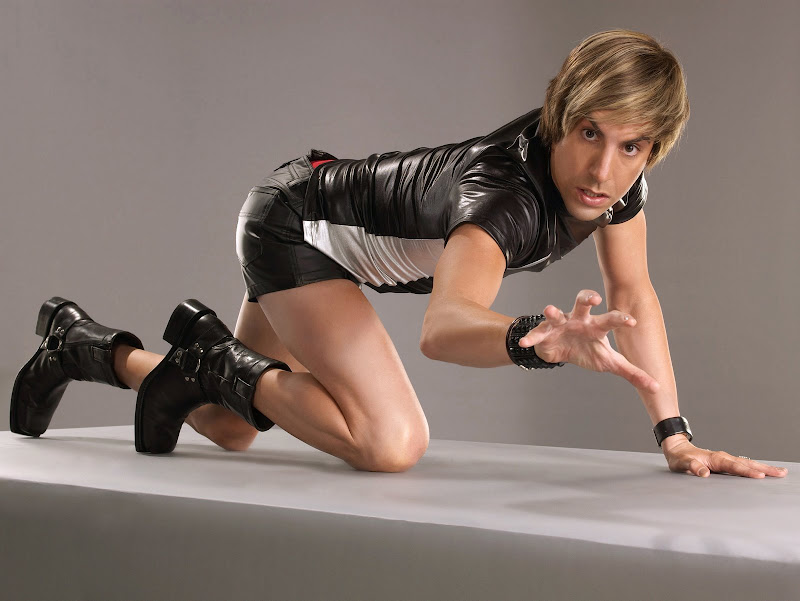
 After a tremendous amount of publicity campaign (remember bare buttocks falling on Eminem's face and nude photos on GQ?), Sacha Baron Cohen, the star from the outrageously hilarious "Borat,", finally meets the audience on a big screen in director Larry Charles's new satire comedy "Brüno" (USA 2009 | 83 min.). Unfortunately, similar like those promotional campaigns, the film is more shocking than funny. It's a big disappointment compared to "Borat."
Sacha Baron Cohen plays his new character Brüno, a gay fashion journalist from Austria who is banned from the fashion world due to his mischief. He decides to move to Hollywood to become a celebrity, and gets rid of his gayness which he blames to be the cause of his failure. He tries to create his own talk shows, sets up humiliating interviews with celebrities, adopts a black baby, and stages gay bashing gatherings only to shock the homophobic crowd by his exaggerated gay acts. However, most of these events (and many more) are just to set up pranks for the audience—if you think you have seen them all, here comes another one. These pranks appear more shocking than entertaining, more offensive than funny, and more juvenile than intelligent. The film takes equal opportunity to offend just about every group: gay, straight, women, Asian, black, Latino, celebrities, and politicians. For a satire film, that's not necessarily a bad thing. What makes these offensive acts remain a tasteless shocker is that they are simply just a shocker, but not funny. For example, the sex scenes of Brüno with his small framed Asian bottom boyfriend (can it be even more stereotype than that?) are cheap shots to beg for a few chuckles. The scene in which Brüno seduces Presidential candidate Ron Paul is simply weird and puzzling than anything else. Certainly not funny.
Director Larry Charles is brilliant at setting up stages to let unknown participants to create comic moments. His previous films such as "Borat" and "Religulous" are smart and hilarious. However, none of those qualities repeat in this new shocker "Brüno." Sacha Baron Cohen is courageous to take up this role and to push the limit beyond boundaries. I cannot think of any other actor who might be willing to perform as he does in this film, even what he is shaking might not be his own penis in this film—and the fact that this film gets an R rating is the last shocker if there are not enough shockers in the film already. "Brüno" opens on Friday, July 10 in theaters.
|
Wednesday, July 1, 2009
Public Enemies
 During the current deep recession, we all already know (or lost track of) how much tax payers' money have been poured into major banks. Those bank CEOs become shameful figures in public eyes. That makes robbing a bank almost a heroic act, hardly criminal. After all, the bankers have been doing that, just without a gun. Intended or not, that's precisely the tone of director Michael Mann's action thriller "Public Enemies" (USA 2009 | 140 min.), about a bank robber's surreal tales during the Great Depression.
John Dillinger (Johnny Depp) is a legendary bank robber during the Great Depression in Midwest. FBI agent Melvin Purvis (Christian Bale) is hand-picked by Edgar Hoover to capture John Dillinger. However, John Dillinger seems able to elude FBI's hunt miraculously and carries on a romantic relationship with Billie Frechette (Marion Cotillard) in and out expensive restaurants, when he is not robbing another bank. John Dillinger is named the Public Enemy Number One, but the "public" really just means the FBI that Hoover is trying to advance. Johnny Depp brilliantly portraits John Dillinger as a handsome, charming, intelligent, loyal, determined, and brave young man. He appears more as an action hero figure, who will do everything for his love, than as an outlawed conman. No wonder Billie falls in love with him despite his high profile as a most wanted criminal. On the contrary, Christian Bale plays Melvin Purvis as a dull, arrogant, cold agent who further direct public's sympathy to John Dillinger. Luckily, the Texas Ranger character Charles Winstead (Stephen Lang) adds much needed intelligence to the law enforcement.
The film is entertaining and captivating for the most part, even with its formulaic story development. It brings John Dillinger's story back to life when the American sinks into another deep recession. However, just don't try to mimic what John Dillinger did, even we all know who are the true public enemies. "Public Enemies" opens on Wednesday, July 1 at Bay Area theaters.
|